
If you're looking to purchase a suppressor or any other NFA Firearm like a Short Barreled Rifle (SBR) and you're not an FFL and SOT, then you're going to need to get a tax stamp.
Want the big picture? Start with our NFA guide.
In this NFA Tax Stamp Guide, we’ll walk you through how to obtain a tax stamp for a suppressor or SBR.
In this article we will cover:
- Class 3 Firearms
- How Much is an NFA Tax Stamp in 2026?
- Suppressor Tax Stamp
- SBR Tax Stamp
- How to Get a Class 3 Firearm Without a Tax Stamp
- NFA Tax Stamp FAQ
To start, we’ll break down which firearm types require tax stamps.
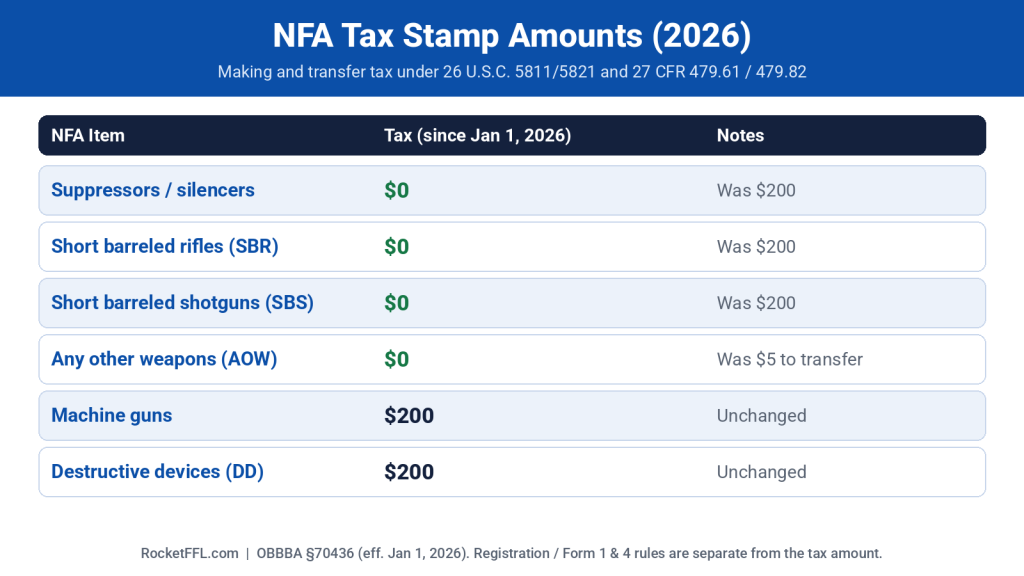
2026 update: Starting January 1, 2026, the NFA tax is $0 for suppressors, short barreled rifles (SBRs), short barreled shotguns (SBSs), and any other weapons (AOWs). It's still $200 for machine guns and destructive devices. The tax amount is separate from registration: machine guns and destructive devices still need an approved ATF form and the $200 tax before you take possession. For suppressors, SBRs, SBSs, and AOWs, see the October 9, 2026 ATF open letter note below. Details are below.
Class 3 Firearms
Tax stamps are required for what many people call "Class 3 Firearms."
The term "Class 3 firearm" is commonly used, but it is a bit of a misnomer. Technically there is no such thing as a Class 3 Firearm - instead, "Class 3" refers to the type of SOT that an FFL is, depending on their type of FFL.
- A Class 3 SOT is a dealer of NFA Firearms (where you're buying your suppressor, SBR, or other NFA firearm).
- A Class 2 SOT is the manufacturer of the NFA Firearm sold by the Class 3 dealer.
- A Class 1 SOT is the importer of any foreign NFA firearm.
SOT Classes
| SOT Class | Purpose | FFL Types |
|---|---|---|
| Class 1 SOT | Importing NFA Firearms | Type 08 and 11 FFLs |
| Class 2 SOT | Manufacturing NFA Firearms | Type 7 and 10 FFLs |
| Class 3 SOT | Dealing NFA Firearms | Type 01, 02, and 09 FFLs |
Despite the terminology technicalities, we'll refer to them here as both NFA firearms and Class 3 firearms.
Here's a list of all the Class 3 firearms that require an NFA tax stamp:
- Suppressors
- Short Barreled Rifles (SBR)
- Short Barreled Shotguns (SBS)
- Machine Guns
- Destructive Devices
- Any Other Weapons (AOW)
The most common "class 3 firearms" are suppressors and short barreled rifles (SBR).
If you'd like to possess one of these and you aren't an FFL, then you'll need to get a tax stamp first.
Tax Stamp
A tax stamp is required for a non-FFL/SOT to possess any NFA Firearm. In other words, you need an approved ATF form before you take possession, and that's still true now that the tax on most NFA firearms is $0.
For FFLs, a once a year tax is paid instead which makes the FFL a Special Occupational Taxpayer (SOT) and a tax stamp for each item is not required.
The National Firearms Act of 1934 (NFA) regulated the "class 3 firearms" above, and required their registration along with the payment of a federal tax for each item.
To get a NFA tax stamp, an application is made with the ATF on either an ATF Form 1 or an ATF Form 4.
The approved NFA application is returned with a stamp showing that the tax has been paid - this is the literal "tax stamp."
How Much is an NFA Tax Stamp in 2026?
Congress cut the NFA tax to $0 for most NFA firearms in the One Big Beautiful Bill Act, effective January 1, 2026. Here's where it stands now:
- Suppressors: $0
- Short Barreled Rifles (SBR): $0
- Short Barreled Shotguns (SBS): $0
- Any Other Weapons (AOW): $0 (it used to be $5 to transfer one)
- Machine guns: $200
- Destructive devices: $200
What the tax cut itself didn't change in the statute: NFA registration and pre-approval still appear in the law for these firearms, along with the background check, photos and fingerprints, CLEO notification, and the SOT that NFA dealers pay. ATF's final rule (effective June 10, 2026) updated the regulations to match the $0/$200 tax rates and allows the tax stamp to be electronic.
You may also have heard about Silencer Shop v. ATF. In August 2026, a federal court in Texas entered a final judgment that bars ATF from enforcing the NFA's registration requirements for these now-untaxed firearms against the plaintiffs and their members and customers. Then, on October 9, 2026, ATF issued an open letter saying that, nationwide, it will no longer require individuals to seek ATF approval under the NFA before making or transferring short-barreled rifles, short-barreled shotguns, silencers, or AOWs, and that it will no longer require those items to be registered in the NFRTR. Machine guns and destructive devices are unchanged: they still need an approved Form 1 or Form 4 and the $200 tax. ATF will still accept voluntary Form 1, Form 3, and Form 4 filings. This is an enforcement policy, not a change to the law, and ATF has said it could change. Gun Control Act rules still apply (for example, a dealer transfer still needs a Form 4473 and NICS), some states still require Form 1 or Form 4 processing, and SOT still applies to NFA businesses. I break it all down in my article on ATF's NFA non-enforcement letter.
ATF Form 1
An ATF Form 1 is used when someone wants to make their own NFA Firearm.
The Form 1 must be returned approved with a tax stamp BEFORE the NFA Firearm is made.
If you are a Type 07 FFL and Class 2 SOT, you can manufacture NFA Firearms whenever you want (no pre-approval needed) and simply submit a different ATF Form notifying the ATF that the class 3 firearm has been made - this is an ATF Form 2.
If you'd like to learn more about the Form 1, check out our ATF Form 1 Guide.
ATF Form 4
An ATF Form 4 is used when a non-FFL is buying a "class 3 firearm" either from a Class 3 FFL Dealer or another individual.
Once the Form 4 is returned with a tax stamp from the ATF, the purchaser can take possession of the NFA Firearm.
If you are an FFL, with any Class of SOT, you'd use another form, the ATF Form 3, to take possession of the "class 3 firearm." As an individual, the wait for an approved eForm 4 is now usually a matter of days: ATF's average for applications finalized in August 2026 was 6 days for individuals and 20 days for trusts on eForms (paper Form 4 averaged 28 days individual / 37 days trust). As an FFL using a Form 3, the wait time is usually only a day or two. These times change, so check ATF's current processing times.
If you'd like to learn more about the Form 4, check out our ATF Form 4 Guide.
In some situations, a Form 4 is filled out using an NFA trust instead of as an individual.
ATF Forms
| ATF Forms | Purpose |
|---|---|
| ATF Form 1 | Permission to make an NFA Firearm by a non-FFL |
| ATF Form 2 | Notification after a Class 3 Firearm is made by an FFL |
| ATF Form 3 | Used for transferring an NFA Firearm between FFLs |
| ATF Form 4 | Used for purchasing a Class 3 Firearm by a non-FFL |
| ATF Form 5 | Used for transferring an NFA Firearm from an FFL to the government |
Suppressor Tax Stamp
The most common tax stamp is for suppressors.
Suppressors, or as I like to call them, silencers, are incredibly popular and legal in most states.
Under the NFA statute, taking possession of a suppressor historically required an approved ATF Form with a tax stamp. See the October 9, 2026 open letter note above for ATF's current nationwide non-enforcement policy on Form 1/Form 4 approval and registration for silencers (and SBRs, SBSs, and AOWs).
If you're not an FFL and looking to buy a suppressor the traditional way, that's a Form 4. If you're looking to build your own suppressor, that's a Form 1. Either way, the tax is now $0. ATF's October 9, 2026 open letter says it will no longer require Form 1 or Form 4 approval/registration for silencers nationwide, but ATF will still accept voluntary filings, GCA dealer rules still apply, and some states still require the federal forms. If you're unsure, file the Form 4 (or Form 1).
Suppressor vs Silencer
The terms suppressor and silencer are completely interchangeable.
I use the term silencer because I am an attorney that specializes in firearms law, and the laws and regulations call them "silencers", so that's the term I use.
However, the term "silencer" sounds scary, and the anti-gun crowd hates them. So, the term "suppressor" is often used instead to make them sound less scary. Also, they don't actually "silence" a firearm - instead, they suppress the noise to safe hearing levels.
SBR Tax Stamp
The next most popular tax stamp is an SBR tax stamp.
SBR stands for "short barreled rifle." An SBR is any rifle that has a barrel length less than 16 inches or an overall length less than 26 inches.
If you're looking to put a short barrel on a rifle you have, the traditional path is an SBR tax stamp on an ATF Form 1. If you're looking to buy an SBR, the traditional path is an NFA tax stamp on an ATF Form 4. The tax for either is now $0. Under ATF's October 9, 2026 open letter, ATF is not currently requiring Form 1 or Form 4 approval/registration for SBRs nationwide (machine guns and destructive devices are unchanged), but GCA dealer rules still apply, some states still require the federal forms, and the policy can change.
ATF Form 4
The ATF Form 4 is used for transferring an NFA Firearm from an individual or an FFL to a non-FFL.
A purchaser fills out the Form 4 and submits it to the ATF along with a photograph, fingerprints, and the tax. As of January 1, 2026, the tax is $0 for suppressors, SBRs, SBSs, and AOWs, and $200 for machine guns and destructive devices. Individuals attach one 2x2 photo taken within the last six months and submit fingerprints (FD-258 cards, or an electronic fingerprint file on eForms). If you're buying through a trust or other entity, each responsible person submits an ATF Form 5320.23 with their own photo and fingerprints.
For more, check out How to fill out a Form 4.
ATF Form 1
The ATF Form 1 is used for making your own "class 3 firearm."
Fill out the ATF Form 1 and submit it along with fingerprints, photos, and the tax for the NFA tax stamp ($0 for suppressors, SBRs, SBSs, and AOWs since January 1, 2026; $200 for a destructive device). Non-licensees can't make machine guns at all.
Do NOT have all of the parts to assemble your class 3 firearm (NFA Firearm) or start making it until you have an approved Form 1 back from the ATF.
How to Get a Class 3 Firearm Without a Tax Stamp
If you'd like to get a class 3 firearm, or NFA firearm, without a tax stamp and without waiting on ATF approval, you can get your FFL and become an SOT — including a home-based FFL where zoning allows.
Once you're an FFL/SOT, you pay your SOT once a year (for example, $500 for a Class