
NFA update (October 2026)
In an Oct 12 court filing, DOJ confirmed ATF will no longer enforce the challenged NFA provisions against anyone, but argued the injunction protects only the plaintiffs and specified persons; everyone else relies on enforcement discretion ATF could reverse. See ATF's NFA transfer guidance update.
If you're looking into the ATF Form 1, you're probably thinking about making your own NFA firearm, like a short-barreled rifle (SBR), short-barreled shotgun (SBS), or suppressor (silencer), and you want to do it the right way.
Want the big picture? Start with our NFA guide.
And if you looked into it a year ago, a lot has changed. Here's the short version for 2026:
2026 Form 1 update
- The making tax is $0 for silencers, SBRs, SBSs, and Any Other Weapons (AOWs), effective January 1, 2026. It's still $200 for destructive devices (see my NFA tax stamp guide).
- Form 1 is now optional for some items, federally. Under an October 9, 2026 enforcement policy, ATF says individuals no longer need to file a Form 1 and get approval before making a silencer, SBR, SBS, or AOW. That's a policy that could be rescinded or changed, not a change to the law, and your state's law still applies. Details below.
- There's a new Form 1. ATF revised the form in January 2026. The old CLEO copy is gone from the form, but the federal regulation still requires you to send your chief law enforcement officer a copy. I walk through the new form item by item below.
- Destructive devices haven't changed. They still need an approved Form 1 and the $200 tax.
I'm a firearms attorney, but I'm not your attorney, so this isn't legal advice. It's what you need to know to understand the Form 1 and get through the process. I've helped hundreds of clients, from the biggest firearms manufacturers to the smallest home-based FFLs, and I've helped thousands of people get their FFL and fill out their own ATF forms.
There's also a better option if you want to make NFA firearms whenever you want, with no wait for approval: get your own manufacturer's FFL.
What is an ATF Form 1?
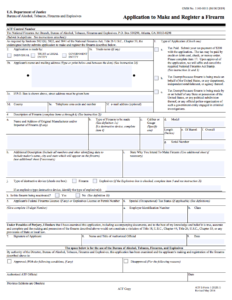
ATF's “Form 1” is ATF Form 5320.1, the Application to Make and Register NFA Firearm. ATF's forms are all versions of Form 5320, and the number after the decimal point is where each one gets its nickname: “Form 1” is 5320.1, “Form 4” is 5320.4, and so on.
A Form 1 is used when a person without the right FFL and SOT wants to make an “NFA firearm.” Types of firearms you may be able to make on a Form 1:
- Suppressor (silencer)
- Short-barreled rifle (SBR)
- Short-barreled shotgun (SBS)
- Any Other Weapon (AOW)
- Destructive device (DD)
Notice what's missing: machine guns. A non-licensee can't make a new machine gun, and ATF will deny a Form 1 for one (18 U.S.C. 922(o)). New machine guns can only be made by a licensed manufacturer who is also a Class 2 SOT, for government use or export. Want to get an FFL and become an SOT? Check out our Get Your FFL and Become an SOT guides.
The Form 1 is an application. It asks ATF for permission to make the item, and approval registers the item to you. The Form 2, on the other hand, is used by licensed manufacturers. It's a notice sent after the item is made, with no permission needed.
Do You Still Need a Form 1 in 2026?
For a destructive device, yes. For a silencer, SBR, SBS, or AOW, ATF now says no, as a matter of federal enforcement policy. But that's not the whole answer, and your state may still require one.
Here's how we got here. Congress cut the making tax on silencers, SBRs, SBSs, and AOWs to $0, effective January 1, 2026. Then, on August 5, 2026, a federal judge in the Northern District of Texas ruled in Silencer Shop Foundation v. ATF that, with the tax at $0, the NFA's registration and making/transfer provisions were no longer an exercise of Congress's taxing power for those items. The court enjoined ATF from enforcing them, but that order covers only the plaintiffs and certain other specified persons.
On October 9, 2026, ATF published an open letter and FAQ announcing that the Department of Justice will use its enforcement discretion to apply that result to everyone. In ATF's words, it “will no longer require individuals to seek ATF approval under the NFA before making or transferring short-barreled rifles, short-barreled shotguns, silencers, and ‘any other weapon[s]’” and “will also no longer require such items to be registered.” ATF's FAQ is direct about the Form 1: “unlicensed individuals no longer need to file a Form 1 and receive ATF approval before making or transferring such items.” I break the whole thing down in my article on ATF's NFA non-enforcement letter.
Here's what that does and doesn't mean for a Form 1:
- It's an enforcement policy, not a change to the law. The NFA is still on the books. ATF itself says enforcement could resume if Congress imposes a new tax, the injunction is dissolved or overturned, or the Department rescinds the policy. Federal law doesn't generally allow later registration of unregistered NFA items, and there's no automatic grandfathering, apart from narrow exceptions like an amnesty the Attorney General could declare.
- Form 1 is voluntary for silencers, SBRs, SBSs, and AOWs. ATF says it will keep accepting and approving Forms 1, 3, and 4 and keep maintaining the registry for anyone who wants an item registered. An approved Form 1 is still the cleanest proof that your item was lawfully made and registered.
- Destructive devices are unchanged. They still carry the $200 making tax and still need an approved Form 1 before you make one.
- Machine guns are unchanged. Non-licensees still can't make them.
- The Gun Control Act still applies. You can't go into the business of making or selling these items without a license, and you can't transfer them to residents of other states or to prohibited persons. ATF also says you still need an approved Form 20 (5320.20) before taking an SBR or SBS across state lines, even if it's unregistered.
- State law still applies. Most states tie their NFA rules to federal registration, and a few ban most NFA items outright. ATF says it “cannot opine” on how state law treats an unregistered item. Many states require NFA items to be registered, which is one reason ATF says it will keep processing applications. Check my summary of the FFLSafe state guide before you make anything.
- Unregistering is one-way. If you ask ATF to remove an item from the registry, ATF says it can't be re-registered unless the Attorney General declares an amnesty.
Bottom line: if you're making a destructive device, or if your state requires registration, or if you simply want an approved, registered item in case the policy changes, file a Form 1 and wait for approval. The rest of this guide covers how to do that.
When to Use a Form 1
A non-licensee files the Form 1 before making the item, submits it with fingerprints and a photo (or photo ID copy) plus any tax, and waits for approval. Under the NFA, approval comes before making. ATF's instructions on the January 2026 form still say “the firearm must not be made until the application has been approved.”
Yes, that means an ordinary citizen can legally (under federal law) make their own NFA firearm at home. Note: that's federal law only. Some states prohibit it.
If you get your FFL and become an SOT, you can make the NFA firearm first and then file a Form 2 to notify ATF. No permission required.
ATF Form 1 Exemption
If you want to skip the forms and the wait, seriously consider getting an FFL. ATF's own Form 1 instructions say a licensed manufacturer (Type 07 or 10) who has paid the special occupational tax is exempt from the making tax and from filing a Form 1. They report what they make on a Form 2 instead.
A Type 07 FFL who is also an SOT doesn't need approval before making NFA firearms. And ATF's October 2026 letter didn't touch the SOT: licensees still need it to be in the business of these items.
Note: the FFL type matters! A Type 01 FFL can NOT make NFA firearms. This gets confusing fast. That's what RocketFFL is for.
Form 1 Suppressor
A Form 1 suppressor is a suppressor (silencer) that someone makes at home after getting an approved Form 1 back from ATF. It's one of the harder NFA firearms to make at home, because it usually takes some machining.
Some companies sell kits, sometimes called “solvent traps,” marketed to people who want to make a Form 1 suppressor. Be very careful with these. With standard firearms, only the frame or receiver is the firearm, and a part that hasn't crossed the “