
How long do FFLs need to keep their records?
As an attorney specializing in ATF compliance for FFLs, this is a fairly common question I receive. Unfortunately, the simplest answer I have is a common answer from attorneys: "It depends." The duration for each ATF record that you need to keep as a Federal Firearms Licensee (FFL) depends on which type of FFL License you have and the specific ATF-required record.
Also, the ATF changed these requirements in 2022 (see the note below).
When I was the federal government relations manager for the firearm industry's trade association, the National Shooting Sports Foundation (NSSF), I created a guide for easy reference for FFLs.
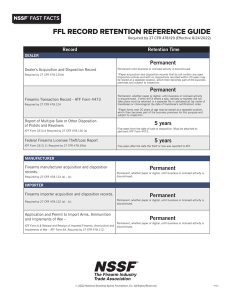
We'll cover the basics of the ATF's record-retention requirements for FFLs here, but I've also included the NSSF guide I created to help make the process easier to understand and follow.
Just click on the image of the guide to view and/or download it for future reference. This is just one example of the great resources the NSSF provides for the industry. If you're an FFL, you should seriously consider joining the NSSF. They protect our industry like the NRA protects gun owners.
Dealer FFL Records
The two most important records for standard dealer FFLs (FFL License Types 1 and 2) are their Acquisition and Disposition (A&D) Records and their Form 4473 transaction records.
As we cover in our online course for getting your own FFL, the ATF is primarily concerned with their ability to trace a gun - these are the main two records that help them!
| Record | Retention Time |
| Dealer's Acquisition and Disposition Record | Until business is discontinued* |
| Firearms Transaction Record, Form 4473 - Transfers | Until business is discontinued* |
| Firearms Transaction Record, Form 4473 - Background Check without Transfer | Until business is discontinued* |
| Multiple Handgun Sales Report, Form 3310.4 | 5 Years |
| FFL Theft/Loss Report | 5 Years |
Manufacturer FFL Records
If you use your manufacturer's FFL (FFL License Types 7 and 10) to conduct transfers to customers (non-FFLs) via 4473s, then you need to reference the information for dealer FFLs above.
| Record | Retention Time |
| Manufacturer's Acquisition Record | Until business is discontinued* |
| Manufacturer's Disposition Record | Until business is discontinued* |
Importer FFL Records
| Record | Retention Time |
| Importation/Acquisition Record | Until business is discontinued* |
| Importer's Disposition Record | Until business is discontinued* |
| Application and Permit to Import, Form 6 & 6A | Until business is discontinued* |
* Note: Under ATF's 2022 rule change (effective August 24, 2022), the records marked above must be kept until your business or licensed activity is discontinued (27 CFR 478.129). The old rule that let you destroy these records after 20 years no longer applies. The only 20-year line left is about storage: paper records over 20 years old (with no open dispositions) may be kept at a separate warehouse, which still counts as part of your business premises and is subject to ATF inspection. When you go out of business, you must deliver your records within 30 days to the ATF Out-of-Business Records Center or to any ATF office in your division, or to your successor if another licensee takes over the business (27 CFR 478.127). ATF proposed returning to set retention periods in May 2026, but that is only a proposal.
If you'd like to get your FFL, make sure and check out our online course for getting your own FFL.
If you already have your FFL, and you'd like to learn more about record retention, we cover all the requirements in more detail in our ATF Compliance course.
Ready to get your FFL?
Step-by-step course from Ryan Cleckner — applications, compliance, and what ATF actually expects.
Get Your FFL Course →
Hi Ryan, from your experience can someone get an FFL, open a web site, and make sales Without transferring the actual firearms? Valid license but fraudulent sales? I have what appears to be a valid organization and FFL – but no response after payment. Worried…..
Anything is possible. If you are concerned about firearm theft, you could contact your local police or the local ATF field division.
I owned and operated the Wilderness Trails Sporting Goods story in Kooskia, ID back in the 1974-75. At that time I had a FFL and Pawnbroker licenses. How may I check to see if my FFL could be reissued, since I do not know what my FFL licenses number was back then. I still do have a copy of my Pawnbroker license, however. Thank you kindly.
Jerry in Montana
There is no process for getting an FFL “reissued.” Instead, you will have to apply for a new/fresh license if you want one. As we cover in our course, you’ll need to reference the earlier FFL even if you don’t have all of the details.
What about the littler documents like FSC tests, Ammo purchases, etc. How long do those need to be kept?
If I’m reading the info above correctly, all 4473s and the A&D books or portions of the A&D books that are older than 20 years can be shredded?
The laws about this are currently changing. This article is for information only and can’t cover every possible scenario. If you’d like guidance here we cover this in our ATF Compliance Course/Program.