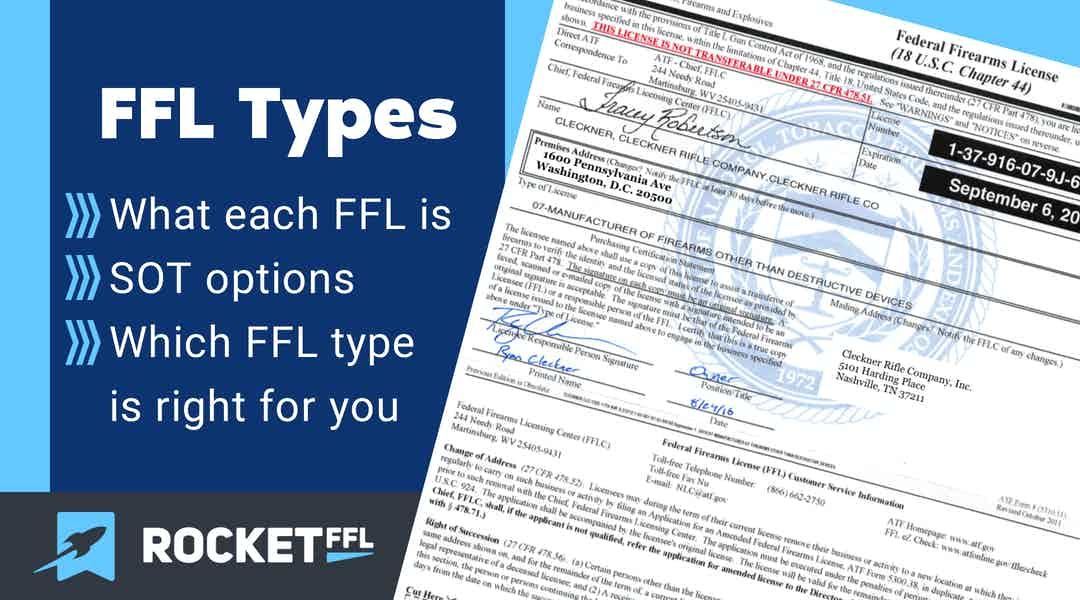
Arizona is a great place to start a firearms business, whether you want to open a gun shop, become a gunsmith, manufacture firearms, or operate a home-based FFL business. The first step is deciding which type of Federal Firearms License (FFL) is right for your business. Then, you'll need to meet the federal requirements and make sure your business complies with Arizona state and local laws.
Unlike some states, Arizona does not have a separate statewide firearms-dealer license that you must obtain after receiving your FFL from the ATF. However, you may still need to register your business, obtain applicable tax licenses, and meet local zoning and business requirements before you begin operating.
As a firearms attorney, best-selling author, and founder of RocketFFL, I've helped more than 20,000 students from all over the country learn how to get an FFL and operate a firearms business. In this detailed guide, I want to show you how to get your FFL in Arizona.
But first, here are a few resources I recommend you check out before we begin:
- Get Your FFL Learning Center
- FFL License Types
- How Much is a Federal Firearm License?
- How to Get a Home Based FFL
- ATF FFL Statistics Learning Center
That Get Your FFL Learning Center link above walks you through the complete process of getting your FFL, but if you want more guidance my Get Your FFL course breaks down the requirements, helps you avoid common mistakes, and gives you the confidence to complete your application correctly. Click the button below if you would like to learn more about it.
Now, let's dive into the guide:
What are the Federal Requirements for an FFL?
The federal requirements for getting an FFL are the same for every state. The federal government requires that you:
- Are at least 21 years of age
- Are a US Citizen or legal permanent resident
- Are legally permitted to possess firearms and ammunition (no felony convictions, have not been a psychological patient or controlled substance user, etc.)
- Have a predetermined location for conducting FFL activities (this includes home-based FFLs)
- Have never violated the Gun Control Act (GCA) or related regulations
- Do not make any false statements/claims on your FFL application
Once you satisfy all of these requirements, you can then move on to Arizona's state-specific requirements.
Arizona’s State Requirements for an FFL
Arizona's requirements for an FFL can be broken down into two categories:
- State licensing requirements
- Business registration requirements
1. Arizona State Licensing Requirements
Arizona is a great place to start a firearms business, whether you want to open a gun shop, become a gunsmith, manufacture firearms, or operate a home-based FFL business. The first step is deciding which type of Federal Firearms License (FFL) is right for your business. Then, you'll need to meet the federal requirements and make sure your business complies with Arizona state and local laws.
Unlike some states, Arizona does not have a separate statewide firearms-dealer license that you must obtain after receiving your FFL from the ATF. However, you may still need to register your business, obtain applicable tax licenses, and meet local zoning and business requirements before you begin operating.
Arizona’s State Requirements for an FFL
Arizona's requirements for an FFL can be broken down into two categories:
- State licensing and tax requirements
- Business registration requirements
1. Arizona State Licensing Requirements
Arizona does not require a separate statewide firearms-dealer license simply because you hold a federal FFL. Your federal license is the primary firearms license you'll need to conduct the activities authorized by that license.
However, this does not mean you can ignore other state requirements.
If you plan to sell firearms at retail, you will generally need to look into Arizona's Transaction Privilege Tax (TPT) licensing requirements through the Arizona Department of Revenue. Depending on your business activities and location, municipal tax or business licensing requirements may also apply.
You can find additional information through the Arizona Department of Revenue.
Be sure to confirm which registrations and licenses apply to your particular business before you begin operating.
2. Arizona Business Registration Requirements
If you're planning to establish a firearms business, you'll also need to determine how to structure and register that business.
Depending on whether you operate as a sole proprietor, LLC, corporation, or another business entity, the registration requirements will vary.
For example, if you plan to form an LLC or corporation in Arizona, you'll need to follow the applicable requirements of the Arizona Corporation Commission. You may also need an Employer Identification Number (EIN), tax registrations, and other business documentation.
Even if your business entity is registered in another state, you may need to register it to conduct business in Arizona.
To get started, visit the Arizona Corporation Commission and Arizona Business One Stop.
What About Arizona’s Local (City/Town) FFL Requirements?
Local zoning requirements are often one of the biggest obstacles when applying for an FFL.
Before submitting your application to the ATF, you need to make sure your proposed business location allows the activities you intend to conduct. This applies to traditional storefronts as well as home-based FFLs.
For example, some cities and counties have zoning rules that restrict commercial activities in residential areas. Others may have requirements involving business hours, customer visits, signage, parking, or other aspects of operating a business.
A home-based FFL may be possible, but you shouldn't assume that your home is automatically an acceptable location just because Arizona doesn't require a separate statewide firearms-dealer license.
Contact your local zoning or planning department to explain the business activities you intend to conduct and confirm whether they're permitted at your proposed location.
You'll also need to make sure your proposed premises meet the ATF's requirements for your chosen license type.
Addressing these issues before applying can help you avoid delays or a potential denial of your application.
And How About the FFL Cost?
An FFL in Arizona costs between $30-$200 for the first 3 years.
When you fill out an FFL application with the Bureau of Alcohol, Tobacco, Firearms, and Explosives (ATF), you choose from several license types.
Each of these license types varies in price due to the different functions they allow the licensee to perform. This includes whether the licensee is just trying to sell a few handguns, incorporate gunsmithing, or handle NFA items, for example.
| FFL License | Application | Renewal | Years |
|---|---|---|---|
| Type 01 | $200 | $90 | 3 |
| Type 02 | $200 | $90 | 3 |
| Type 03 | $30 | $30 | 3 |
| Type 06 | $30 | $30 | 3 |
| Type 07 | $150 | $150 | 3 |
| Type 08 | $150 | $150 | 3 |
| Type 09 | $3,000 | $3,000 | 3 |
| Type 10 | $3,000 | $3,000 | 3 |
| Type 11 | $3,000 | $3,000 | 3 |
To handle NFA items (such as silencers, short-barrel rifles, machine guns, destructive devices, etc.), you must pay additional costs in the form of an SOT license registration.
For a full breakdown of the cost of an FFL, I have a full guide you can check out here.
The 4 Steps to Getting Your FFL in Arizona
Before we wrap up, I want to give you a high-level overview in a step-by-step guide. To get your AZ FFL, do these.
Step 1: Ensure You Meet FFL Federal Requirements and Arizona State Requirements
First, make sure that you meet all Federal requirements for FFL holders. As I mentioned earlier, these are the same for every state in America. And you'll need to make sure you meet the Arizona state requirements I mentioned earlier too.
Step 2: Choose Your FFL Type
Next, you need to apply for the appropriate type of FFL. Depending on what you are trying to do with your business, choose the license type that allows you to lawfully operate your firearms business.
More often than not, you will probably need either a Type 01 license (for most firearms dealers and gunsmiths) or a Type 07 license (for manufacturing). Type 07 license holders may both manufacture and sell firearms.
To determine what type of FFL best suits your needs, this article of mine breaks it down.
| FFL License Type | FFL License Purpose | SOT Class |
|---|---|---|
| Type 01 FFL | Dealer/Gunsmith of Firearms | 3 |
| Type 02 FFL | Pawnbroker/Dealer of Firearms | 3 |
| Type 03 FFL | Collector of Firearms | n/a |
| Type 06 FFL | Manufacturer of Ammunition | n/a |
| Type 07 FFL | Manufacturer/Dealer of Firearms and Ammunition | 2 |
| Type 08 FFL | Importer/Dealer of Firearms | 1 |
| Type 09 FFL | Dealer of Destructive Devices | 3 |
| Type 10 FFL | Manufacturer/Dealer of Destructive Devices | 2 |
| Type 11 FFL | Importer/Dealer of Destructive Devices | 1 |
Some types of firearms and accessories require you to be an SOT (Special Occupational Taxpayer). You’ll apply as an SOT after being assigned your FFL number. These requirements are from the National Firearms Act of 1934 (NFA), later updated with Title II of the Gun Control Act.
You’ll need to be an SOT if you plan to sell these NFA items:
- Silencers
- Full-auto machine guns
- Short-barreled rifles (rifles with a barrel shorter than 16″ or an overall length under 26″)
- Short-barreled shotguns (shotguns with a barrel shorter than 18″ or an overall length under 26″)
- Destructive devices (grenades, mines, bombs, etc.)
- Any other weapons (pen guns, specific special handguns, etc.)
The table above describes each FFL License type and which SOT Class you’ll need to apply for after getting your FFL to sell firearms covered under the NFA.
We cover all of the specifics of SOT classes and the NFA in our Get Your FFL Course, which I'll talk about next.
Step 3: Take an FFL Course
Next, I recommend taking an FFL course from a qualified instructor.
FFL license logistics can be complex. That's why I developed my course based on decades of research and work as an attorney in the firearms industry to help you get your FFL hassle-free. It covers the federal-level information you need to apply for your FFL and everything you need to know to get your FFL in Arizona.
I also highly recommend that you get the FFL Course and SOT Course combo. For an extra $10, you'll learn how to apply to buy and sell silencers and Short Barreled Rifles (SBRs) in addition to standard firearms covered by just your FFL. Select the course add-on at checkout for both courses.
Step 4: Submit Your FFL Application Forms
Finally, once you’ve made sure you meet all requirements (federal and state), verified the appropriate FFL type for your business, and taken the proper training, you are ready to “pull the trigger” and apply for your FFL!
Once you submit all the forms required by the ATF, they will start the process by completing a background check on all “responsible persons'' for the business. A responsible person (RP) is either the sole proprietor, a partner in the corporation, or will influence the business’s practices and policies.
Once all application paperwork is verified as correct and all background checks are complete, the application is sent to a local ATF field office. An industry operations investigator (IOI) will set up an in-person interview with you to make sure all information is still correct and that you are following all state and local requirements.
After the interview, the IOI will make a recommendation to either approve or deny your FFL application. Assuming you passed, the ATF field office supervisor will then submit the approved application to the Federal Firearms Licensing Center (FFLC), and you will be the next owner of an FFL!
According to the ATF website, the entire process takes about 60 days from when a completed application was first received. However, depending on the state you are setting up in, the ATF may require multiple forms and extra steps during the process.
This may require multiple forms and extra steps, depending on where you live. However, if you took the Rocket FFL course, you’ll have every detail and access to all the necessary forms to quickly apply for your Federal Firearms License.
Final Word on Getting an FFL in AZ
As you can see, getting your Arizona FFL is straightforward with the proper guidance! As long as you meet the Federal and State requirements, choose the appropriate license type, and fill in the proper forms, you'll be on your way to being the newest FFL in Arizona.
But, if you’re unsure about any of these requirements or what steps to take next, I cover the entire process in detail in my Get Your FFL course. With it, you can, with confidence, fill out your forms and get through the process with ease.
Trust me, knowing that you are running your business safely and within all the confines of both federal and local laws will be a massive load off your mind. So if you're ready, let's get started
Common Questions for Arizona FFL Licensing
An FFL in Arizona costs anywhere from $30 to $200 for 3 years. For a full breakdown of the cost of an FFL, check here.
Yes! If you plan to sell, transfer, manufacture, or do anything else for profit involving firearms, you are legally required to have an active FFL.
Yes, you are required to apply for a Arizona license to sell firearms through the county sheriff.
Yes, if you are forming a business for your FFL, it must be registered in Arizona.
No, you should not get an FFL just to save money on guns. One of the main requirements for getting your FFL is “business intent,” meaning you intend to operate a firearms-related business.
However, you may wait to start your business until after you get your FFL number.
Extra Resources For Getting an Arizona FFL
US Code § 923: Code § 923 covers federal regulations for the import, manufacture, and dealing of firearms and ammunition. This is the federal law that requires those operating firearms businesses to get an FFL.
US CFR § 478.47 - Issuance of license. This code explains how a Federal Firearms License is issued, including who must assign the license number. It requires the ATF (Bureau of Alcohol, Tobacco, Firearms and Explosives) to qualify applicants based on a predetermined list of requirements and to issue Federal Firearms Licenses.
If a correctly submitted FFL application has been submitted on ATF Form 7, the Chief of the Federal Firearms Licensing Center (a department at the ATF) must issue the license and assign a serial number to the licensee.
Gun Control Act (GCA): The GCA of 1968 establishes stricter laws on the firearms industry than were already present in the NFA. New regulations regarding firearms offenses, firearms/ammunition sales to “prohibited persons,” and federal jurisdiction for “destructive devices” (bombs, grenades, mines, etc.) were created with the GCA.
Starting a Business in Arizona: Need help finding out where to start with your new business? Check out this article from the Arizona Corporation Commission showing you how to do just that!
FFL Types: Use this guide to make sure that you choose the right type of Federal Firearms License for what you want to do.
Home-Based FFL: Don’t want to pay for a storefront but wish to operate as an FFL holder from your home? We explain how to do it from start to finish.
Ready to get your FFL?
Step-by-step course from Ryan Cleckner — applications, compliance, and what ATF actually expects.
Get Your FFL Course →