
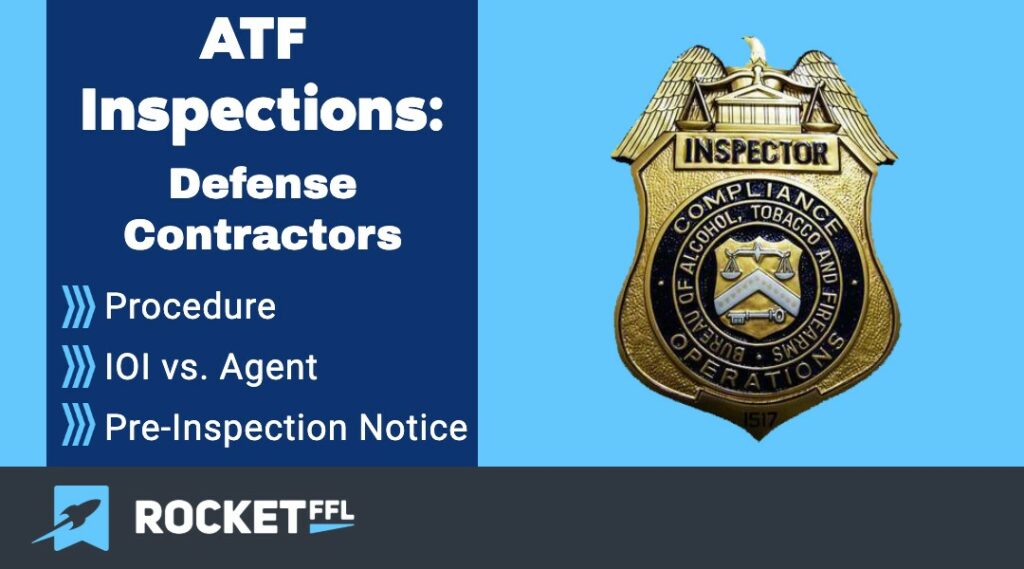
Today, the ATF released an overview of the inspection process for FFLs who are also Department of Defense Contractors.
You can view/download the ATF Inspection Process for DOD Contractors, or read it in full below.
NOTE: This process is similar to, but different from, the standard ATF inspection process that applies to FFLs who are not also Department of Defense (DOD) contractors.
In this article we're going to cover:
ATF Inspections
Generally, the ATF may not conduct a compliance inspection of an FFL more than once during any 12-month period.
This means that after an inspection where no major issues are found, the ATF can not come back to inspect that license again until at least 12 months have passed.
As we cover in our course on how to get your FFL, the ATF will visit with you as part of your FFL application process. This visit counts as an inspection! Therefore, you can't get a regular compliance inspection during your first year as an FFL!
A full guaranteed year of no inspections is both good and bad. It's good because you can focus on getting your business running without worrying about a surprise visit from the ATF. It's bad for some FFLs because they may not have taken the time to learn about ATF Compliance and therefore might have a whole year of bad habits/errors that they don't learn about until their first inspection (often a few years later). And, once they learn about it during an inspection, it's too late - the warnings are often in the form of formal violations of the law and ATF regulations.
Inspectors vs ATF Agents
ATF agents do not conduct inspections!
If you have an agent present during your inspection, you need to call your lawyer. A consultant won't cut it - you need YOUR actual attorney on the phone. If you're interested in official legal representation before it's too late, contact a local firearms' attorney.
ATF inspections are conducted by "inspectors"... go figure. An Industry Operations Inspector (IOI) is an employee of the ATF without law-enforcement authority. However, they do report their findings to the other half of the ATF, the actual Agents, who are federal law enforcement officers.
Here's how you can tell the difference between an IOI and an ATF agent: First, ask who each person is! Both IOIs and Agents will clearly tell you who they are. Second, look for a gun. Agents carry guns, IOIs don't.
Why should you care?
The ATF has the authority to inspect your licensed activity (they don't have the authority to search things or records that aren't part of your FFL or that aren't specifically part of a normal ATF inspection) during a compliance inspection. If an Agent is present, it is a criminal investigation - Agents are not allowed to use the ATF's administrative authority for compliance inspections.
I have been on many phone calls with clients during inspections where I have politely asked (rarely, sternly told) Agents to immediately leave the premises and come back with proof of an active criminal investigation or a search warrant.
Think about it this way: if a building inspector comes into your home to check for a gas leak, that doesn't mean that a police officer is allowed to accompany the inspector into your home to search through your things without your express permission or a search warrant.
DOD Contractor FFLs
FFLs, who are also Defense Contractors, have compliance responsibilities for both DOD and commercial activities.
There are special record-keeping requirements, security and safety protocols and procedures, and firearm/explosive segregation standards to follow once an FFL also becomes a DOD contractor. For example, a recent ruling by ATF, ATF Ruling 2016-5, applies only to marking variances for Defense Contractors.
Pre-Inspection Notification by the ATF
The biggest difference between the standard ATF inspection process for FFLs and the inspection process for DOD contractors is the potential for a pre-inspection notification from the ATF.
Note the use of the word "potential." There is no guarantee that the ATF will call ahead an notify a DOD contractor FFL of an inspection. Even the ATF uses the word "generally" in this recently released guidance when referring to when an IOI will give advance notice.
It is common for Defense contractors to get a pre-inspection notice - however, it is uncommon for a standard FFL to get an advance notice. Instead, the ATF typically shows up and lets an FFL know that an inspection is starting.
Of course, there are many other differences - the sections below referring to Defense contracts and the extra associated requirements, obviously aren't part of the ATF's normal inspection process for FFLs.


0 Comments