
Depending on whether you want to make, buy, or sell an NFA firearm, there is an ATF Form that must be used.
Want the big picture? Start with our NFA guide.
This is because, in most cases, the ATF must approve the making, selling, and/or buying of NFA firearms, those firearms regulated under the National Firearms Act (e.g. silencer or suppressor, short barreled rifle or SBR, short barreled shotgun or SBS, machine gun, and more).
The application for making or transferring an NFA firearm is made on the appropriate ATF form along with a fingerprint card and any tax due to the ATF (since January 1, 2026, the tax is $0 for suppressors, SBRs, SBSs, and AOWs, and still $200 for machine guns and destructive devices; see our NFA tax stamp guide) and, once approved by the NFA branch, it is returned with a tax stamp and permission for either making the NFA item or permission for the transferor (seller) to allow the transferee (buyer) to take possession of the NFA item.
There is one exception to the "prior approval required" guideline: if you are a Type 07 or Type 10 FFL (the two types of manufacturing federal firearms license) AND you have paid your annual SOT tax and are thereby a Special Occupational Taxpayer (Class 2 for those who want to know), then you can make a machine gun whenever you want and simply notify the ATF - NFA Branch AFTER you've made the NFA item. There is no "approval" in this case - instead, it is simply a notification.
One big limit on machine guns: federal law (18 U.S.C. 922(o)) bans the transfer and possession of machine guns made after May 19, 1986, except for government and law enforcement use. So a Type 07 or 10 FFL/SOT can make new machine guns, but generally only for government or law enforcement sales, for export, or as dealer samples for qualifying SOTs, not for sale to the public. Other NFA items, like suppressors and SBRs, don't have this restriction.
What about ATF's October 9, 2026 open letter? That letter speaks to Form 1 and Form 4 for suppressors, SBRs, SBSs, and AOWs. It doesn't change the Form 3 process for tax-exempt transfers between SOTs covered in this guide.
ATF Forms
Which ATF form is used depends on the activity and the person or entity making, selling, or receiving the firearm.
Here is a table showing which ATF form is used for which type of activity and transferee, followed by a breakdown of each type of ATF paperwork for NFA transfers:
NFA Forms
| NFA Form | Purpose | Manufacturer or Transferee (recipient) | ATF Approval Needed? |
|---|---|---|---|
| Form 1 | Making NFA Firearm | Non-FFL/SOT (regular individual/entity) | Yes |
| Form 2 | Making NFA Firearm | Type 7 or Type 10 FFL (Class 2 SOT) | No |
| Form 3 | Transferring NFA Firearm | FFL / SOT (Any Class SOT) | Yes |
| Form 4 | Transferring NFA Firearms | Non-FFL/SOT (regular individual/entity) | Yes |
| Form 5 | Transferring NFA Firearm | Government Entity (Mil, LE, etc) | Yes |
| Form 6 | Importing NFA Firearm | Type 8 or 11 FFL (Class 1 SOT) | Yes |
| Form 9 | Exporting NFA Firearms | Foreign Recipient | Yes |
| Form 10 | Register Acquired/Seized NFA Firearm | Law Enforcement / Government | Yes |
- ATF Form 1 is used for non-FFLs to manufacture their own NFA item at home. This includes all NFA firearms except a machine gun (fully automatic weapon). This is commonly used to convert a rifle to a short barreled rifle or to make a homemade silencer out of a kit (sometimes called a solvent trap).
- ATF Form 2 is used by manufacturer FFLs to notify the ATF that an NFA firearm has been made (importers also use it to report NFA firearms they import).
- ATF Form 3 is used when transferring an NFA item from one FFL/SOT to another FFL/SOT (often from a manufacturer or distributor to a Class 3 dealer).
- ATF Form 4 is used when transferring an NFA weapon from an FFL to a non-FFL individual or gun trust (often from an FFL dealer to a customer - either a person or NFA trust).
- ATF Form 5 is used when transferring an NFA weapon from an FFL to a government entity like a law enforcement agency, military unit, or other government entity.
- ATF Form 6 is used when importing an NFA firearm.
- ATF Form 9 is used to export an NFA Firearm permanently.
- ATF Form 10 is used by a government entity to properly register a seized or acquired NFA firearm that wasn't previously registered.
ATF Form 3
ATF Form 3 (ATF Form 5320.3, "Application for Tax-Exempt Transfer of Firearm and Registration to Special Occupational Taxpayer") is used to transfer an NFA item from one Federal Firearms Licensee (FFL) to another, when both are also Special Occupational Taxpayers (SOTs).
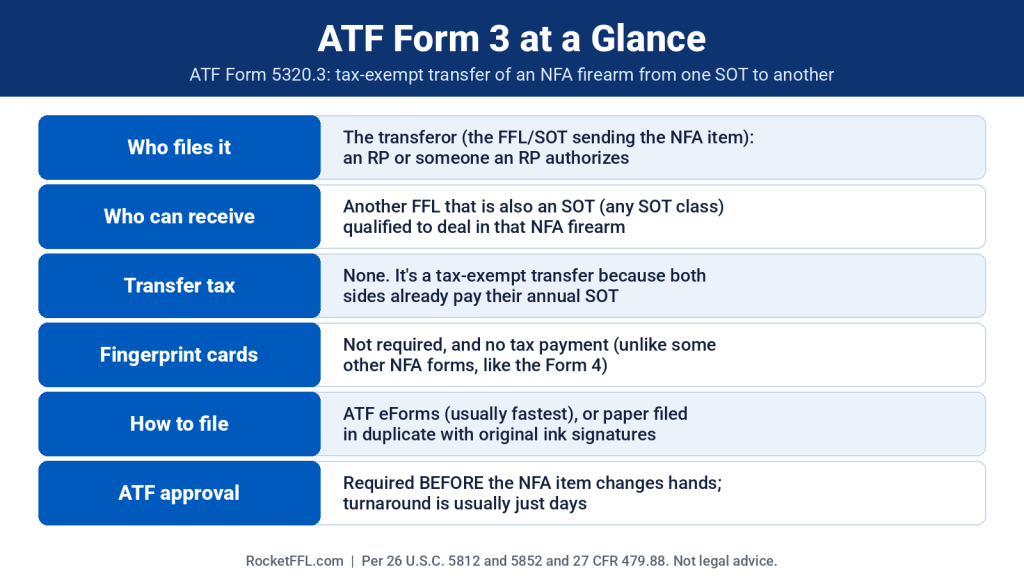
The bad news is that ATF approval is required from the NFA branch prior to transferring the NFA weapon. However, the good news regarding the Form 3 is that processing and turnaround time for the ATF paperwork is generally very fast (a matter of a couple of days; ATF's posted averages for applications finalized in October 2026 were 1 day on eForms and 4 days on paper).
Both FFLs must also be SOTs to use the Form 3, so they have already paid their tax to deal with NFA firearms. This means that the application to the ATF on the Form 3 is a tax-exempt transfer.
If you're interested in becoming an FFL, you should check out our How to Get Your FFL course.
To be more accurate, the Form 3 isn't used from one FFL to another but rather from one taxpayer to another. This is true for all ATF forms for transfers - they are for transferring from one taxpayer to another.
So, if one company has multiple locations, each with an FFL, then that company may freely move the NFA items between locations without a Form 3 even though the NFA firearm is moving from one FFL to another because the company, in the example I'm giving, is the same company and therefore has the same EIN (taxpayer number) for each location.
Be careful with advanced topics like this on your own - you should strongly consider joining our ATF compliance program before tackling nuanced ATF compliance issues like this.
ATF Form 3 Application
There is no CLEO copy of the Form 3; both copies of the paper form go to the ATF. Other forms, like the Form 4, also include a CLEO Copy (chief law enforcement officer) for local law enforcement notification.
A Responsible Person (RP) for the gun dealer or manufacturer, or someone designated by the responsible person, makes the application to send the firearm to another taxpayer FFL on the Form 3.
A completed form will include all information about each FFL and also information about the firearm(s) to include dimensions and serial number.
Also, unlike some other NFA forms, there are no fingerprint cards nor payments of a transfer tax for the Form 3. So issues about paying via check or credit card for your tax stamp are not a concern (SOTs have their one tax stamp they need for the whole year - not per item).
If you're interested in becoming an FFL and SOT, check out our course bundle.
A few days after it is submitted, the ATF Form 3 should come back approved. Then, and only then, may the firearm change possession from the transferor to the transferee.
It does not matter whether the paper form or the el