
Texas has over 10,400 active Federal Firearms Licenses (FFLs) in the state, making it one of the leading states for firearms businesses. If you're thinking about getting a Federal Firearms License (FFL) in Texas so that you can be a gun manufacturer or firearms dealer (even from your home) in the lone-star state, then you're in the right place.

Most of the requirements for obtaining an FFL are established by federal laws and regulations. However, each state may also have additional requirements that must be met before you can operate as a licensed firearms dealer.
Thankfully, Texas is gun friendly.... but, there are still some things to watch out for. As we'll explore more later, local zoning laws can be tricky and can cause a problem for getting your FFL (especially if you don't know the right way to navigate them).
Let's take a quick overview of the basic federal requirements and then dig into everything that is required to get your FFL in Texas.
But first, here are a few resources I recommend you check out before we begin:
- Get Your FFL Learning Center
- FFL License Types
- How Much is a Federal Firearm License?
- How to Get a Home Based FFL
- ATF FFL Statistics Learning Center
That Get Your FFL Learning Center link above walks you through the complete process of getting your FFL, but if you want more guidance my Get Your FFL course breaks down the requirements, helps you avoid common mistakes, and gives you the confidence to complete your application correctly. Click the button below if you would like to learn more about it.
What are the Federal Requirements for an FFL?
The federal requirements for getting an FFL are the same for every state. The federal government requires that you:
- Are at least 21 years of age
- Are a US Citizen or legal permanent resident
- Are legally permitted to possess firearms and ammunition (no felony convictions, have not been a psychological patient or controlled substance user, etc.)
- Have a predetermined location for conducting FFL activities (this includes home-based FFLs)
- Have never violated the Gun Control Act (GCA) or related regulations
- Do not make any false statements/claims on your FFL application
Once you satisfy all of these requirements, you can then move on to Texas' state-specific requirements.
Texas State Requirements for Getting an FFL
State requirements for an FFL can be broken down into two categories:
- State licensing requirements, and
- Business registration requirements
Some states require extra licensing or registration for FFLs and all states require business registration.
1. Texas FFL Licensing Requirements
Good news! Texas has no special licensing requirement for FFLs.
This means that your FFL is all you'll need to be engaged in the business of firearms in Texas.
If you move your FFL to another state, however, you may have state-level registration requirements in your new state.
2. Texas Business Registration Requirements
Just as with any other state, you'll need to register your business with the State of Texas.
If you register your business in another state (we suggest this in our Get Your FFL course), you'll still need to have an official presence in Texas.
To register your FFL business in Texas, you should check out the steps to starting a TX business by the Texas Department of Economic Development which cover registering with the Texas Secretary of State and the Texas Business Permit Office (if necessary).
What About Texas’ Local (City/Town) FFL Requirements?
Local zoning issues can be one of the biggest hang-ups for people applying for their FFL.
Getting around zoning issues is not that hard once you know a few tricks.
But, you MUST ensure that the location you have chosen (most often a home-based FFL) allows for a business.
Unfortunately, too many people are told that they can't have an FFL in a residential area and they give up. Very often, the restrictions on business in certain areas are due to a misunderstanding about business activity.
For example. zoning departments hear "FFL" and they assume heavy foot traffic and retail activities, But, most home-based FFLs are only occasionally having a customer stop by and aren't going to be having retail-level traffic.
We cover this and more, including business hour requirements, in our Get Your FFL course.
And How About the FFL Cost?
The cost of obtaining an FFL in Texas ranges from $30 to $200 for the initial three-year license period.
The price for an FFL in Texas varies depending on which FFL Type you choose.
If you get a Type 01 FFL, the most popular license type, to buy and sell guns as a firearm dealer and/or be a gunsmith, it will cost $200 for the first three years and then only $90 for every three-year license renewal thereafter.
If you'd like to make guns for sale, you'll want the second most common type of federal firearms license, a Type 07 manufacturers FFL. The Type 07 FFL costs $150 for the first three years and also for every three-year renewal.
As you can see, it's cheaper for the first three years to get a Type 07 FFL for manufacturing firearms (which also allows you to sell them) but the Type 01 FFL for dealers and gunsmiths is less expensive in the long run.
There are some other costs to be considered to getting a TX FFL, if you'd like to learn more, checkout our breakdown of all the FFL costs.
| FFL License | Application | Renewal | Years |
|---|---|---|---|
| Type 01 | $200 | $90 | 3 |
| Type 02 | $200 | $90 | 3 |
| Type 03 | $30 | $30 | 3 |
| Type 06 | $30 | $30 | 3 |
| Type 07 | $150 | $150 | 3 |
| Type 08 | $150 | $150 | 3 |
| Type 09 | $3,000 | $3,000 | 3 |
| Type 10 | $3,000 | $3,000 | 3 |
| Type 11 | $3,000 | $3,000 | 3 |
The 4 Steps to Getting Your FFL in Texas
Before we wrap up, I want to give you a high-level overview in a step-by-step guide. To get your TX FFL, do these.
Step 1: Ensure You Meet FFL Federal Requirements and Texas State Requirements
Before you start the FFL application process, you MUST make sure that you meet the federal FFL requirements (included below).
There are also some location requirements, like Texas state requirements and zoning rules, that you'll also have to meet (included below) for all FFLs.
If you're looking into getting a home-based FFL, there are a few tricks – I share all of these and more in the Get Your FFL Guide.
Step 2: Choose the right type of FFL
The type of FFL that is right for you depends on what you want to do with it.
If you want to be a firearm dealer and/or be a gunsmith, then you’ll only need a Type 1 FFL.
If you want to manufacture firearms, then you’ll need a Type 7 FFL. It’s important to note that a Type 7 Federal Firearms License also lets you be a firearms dealer – therefore, if you want to manufacture and sell firearms, a Type 7 FFL covers both!
The Type 1 FFL is, by far, the most popular followed by the Type 7 FFL. To learn more, check out FFL Types.
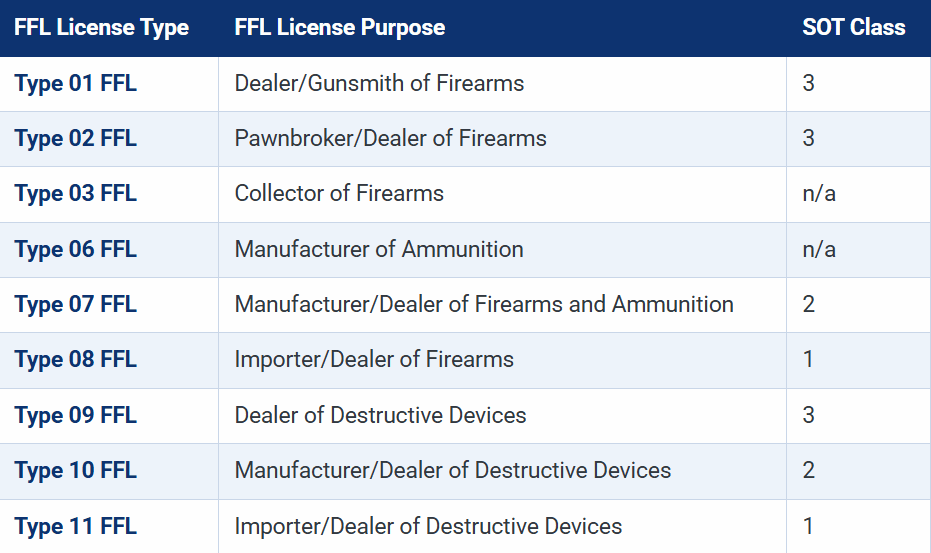
In the table below, we show you what each FFL License type is for. You'll see some information about "Class" this refers to the Class of SOT (for NFA Firearms). If you're not sure what this is, don't worry, we cover all of this in our Get Your FFL Guide. Also, you can check out our SOT License Guide.
Step 3: Take an Online FFL Course
The actual process of getting your FFL License can be difficult.
Sure, you can do it on your own (I have). But, if you want to make sure that you set it up the right way and don't run into any troubles later, please consider taking out FFL License course.
Yes, this step is telling you about a course we sell. But, encouraging you to learn more isn't just a sales pitch. I am a firearms attorney that specializes in ATF compliance and I'd make much more money letting people get their FFL the wrong way and then charge them my hourly rate later to fix it. I don't want that. You don't want that.
Step 4: Submit Your FFL Application Forms
After you've made sure that you meet the requirements for an FFL, you selected the right type of FFL for your needs, and taken your course, you’re finally ready to apply for your Federal Firearm License.
Now, the steps to this can be very difficult and may require multiple forms and extra steps depending on your location.
However, if you took the Rocket FFL course, you’ll have every detail and access to all the necessary forms in order to get your own Federal Firearms License hassle free.
How to Get a Texas Class 3 License
Getting a class 3 license in Texas starts with getting your FFL.
After you have your FFL, you can then register to become a Special Occupational Taxpayer (SOT) to start working with NFA firearms.
Technically, there’s really no such thing as a “Class 3 License.” Instead, "Class 3" is the class of SOT that an FFL needs to be in order to sell NFA Firearms like suppressors (silencers), Short Barreled Rifles (SBRs), Short Barreled Shotguns (SBS), Full-Auto Machine Guns, and “Any Other Weapons” (AOWs).
There are also other Classes of SOT for FFLs who make those NFA firearms and for those who import them.
We walk you through the whole process in our Class 3 License Guide.
Also, you can learn more about becoming an SOT in our SOT License Guide.
Final Word on Getting an FFL in TX
Getting your FFL in Texas is one of the easiest states to got your license.
There are no extra state requirements for getting an FFL License and the local zoning requirements are the same as any other state.
Of course, having Texas being so gun-friendly doesn't hurt.
If you're ready, get started with your Texas FFL today.
Common Questions for Texas FFL Licensing
Q: Does Texas require extra licensing for FFLs?
A: No, there are not extra licensing requirements for FFLs in Texas
Q: Do I need to register a business for an FFL in Texas?
A: Yes, if you are forming a business for your FFL, then it must be registered in Texas.
Q: How much does an FFL cost in Texas?
A: An FFL in Texas costs anywhere from $30 to $200 for 3 years. For a full breakdown on the cost of an FFL, check out How Much Does an FFL Cost?.
Extra Resources For Getting a Texas FFL
US Code § 923: Code § 923 covers federal regulations for the import, manufacture, and dealing of firearms and ammunition. This is the federal law that requires those operating firearms businesses to get an FFL.
US CFR § 478.47 - Issuance of license.: This code explains how a Federal Firearms License is issued, including who must assign the license number. It requires the ATF (Bureau of Alcohol, Tobacco, Firearms and Explosives) to qualify applicants based on a predetermined list of requirements and to issue Federal Firearms Licenses.
If a correctly submitted FFL application has been submitted on ATF Form 7, the Chief of the Federal Firearms Licensing Center (a department at the ATF) must issue the license and assign a serial number to the licensee.
Gun Control Act (GCA): The GCA of 1968 establishes stricter laws on the firearms industry than were already present in the NFA. New regulations regarding firearms offenses, firearms/ammunition sales to “prohibited persons,” and federal jurisdiction for “destructive devices” (bombs, grenades, mines, etc.) were created with the GCA.
Starting a Business in Texas: Need help finding out where to start with your new business? Check out the Texas Business Division showing you how to do just that!
FFL Types: Use this guide to make sure that you choose the right type of Federal Firearms License for what you want to do.
Home-Based FFL: Don’t want to pay for a storefront but wish to operate as an FFL holder from your home? We explain how to do it from start to finish.
Ready to get your FFL?
Step-by-step course from Ryan Cleckner — applications, compliance, and what ATF actually expects.
Get Your FFL Course →
My brother -in- law and I are thinking about opening a business. He is the money and the owner. Unfortunately he has a felony from his young adulthood. My question is, can I apply for the FFL or does him being the owner kind of dampen that?
Him being the owner absolutely dampens that. As a felon, he is not allowed to be in possession of firearms nor ammunition.
If you want to get an FFL, you’ll need to do it as your own business without his money or control.
There is one way to try to make it work, but it is legally complicated and expensive.
That is what I was afraid of. Thank You for your quick reply.
In Texas, even a felony conviction does not prevent you from owning a gun after 5 years of the date of conviction, however, obtaining an FFL is not an option under federal law.
I already have an existing business, Inc., registered in Texas – have EIN number. This business was setup for non FFL related. I would think theres no reason that I can not use the business for FFL related work, it that correct???
Correct.
The ATF(field office) agent assigned to my application requested that I withdrawal my application and re-apply once I have secured a new office space due to my neighborhood POA restricting ANY AND ALL HOME BUSINESSES in my rural neighborhood. There is no local zoning issues, just these amended POA restrictions, even though the majority of property owners in our neighborhood advertise their home address as their business address online and in printed publications. I am pretty sure this POA is voluntary too. Should I hire a real estate attorney to review these restrictions and POA Bylaws? or the title company we used to purchase 20 years ago, and a couple recent refi’s? Is it worth my time trying to fight this with the property owners association?? My application process was going smoothly, no hic ups, until the agent asked me for authorization from our POA, I submitted the request, they denied.
I currently have an 03 FFL and will be taking your course to upgrade. There is a property (separate stand alone building) about 200ft from a restaurant/bar. I can’t find anything for Texas on restrictions / guidelines for distances. I’m assuming this is fine since there are other gun shops in strip malls where alcohol is served. Thanx – And HOOAH !!
We’re excited to hear that you’re going into business!
I will be travelling to Canada later this summer where my parents still reside and I wanted to know if I needed to do anything special in order to bring back my grandfather’s old 12 gauge shot gun that was left to me. I am a US citizen residing in Texas. The gun was a gift to me. I checked with the ATF and they said that, “Unlicensed residents of the United States (individuals who do not possess a Federal Firearms License) may not import firearms into the United States. You may contact a Federal Firearms Licensee who may submit the ATF Form 6 Part I requesting consent to import the firearm into the United States. Please note that if the application is approved, you may not import the firearm, only a responsible person under the FFL may do so.” I live n Fort Worth and wanted to know how to get the above requirement accomplished, i.e. what do I need to do.
-Thanks
You should find an FFL that imports firearms and hire them to import it for you.
I live with my daughter and son-in-law at their home. Am I able to get an FFL at that location?