With the federal tax on suppressors now $0 and ATF no longer enforcing NFA registration for them, a lot of people are asking me how to get into the business of making suppressors. Demand is up, and the barriers for buyers are lower than they've been in decades.
Want the big picture? Start with our NFA guide.
But making suppressors to sell is still a licensed, regulated business. Here's the federal path: the license, the SOT, marking, records, Form 2, and a few traps to avoid.
The Short Answer: A Type 07 FFL Plus a Class 2 SOT
A suppressor (silencer) is a "firearm" under the Gun Control Act (18 U.S.C. 921(a)(3)), and making firearms as a business requires a manufacturer's license (18 U.S.C. 922(a)(1)(A), 923(a)). For most people, that's a Type 07 FFL. And because suppressors are also covered by the National Firearms Act, anyone in the business of making them has to pay the Special Occupational Tax as a manufacturer, called a Class 2 SOT (26 U.S.C. 5801).
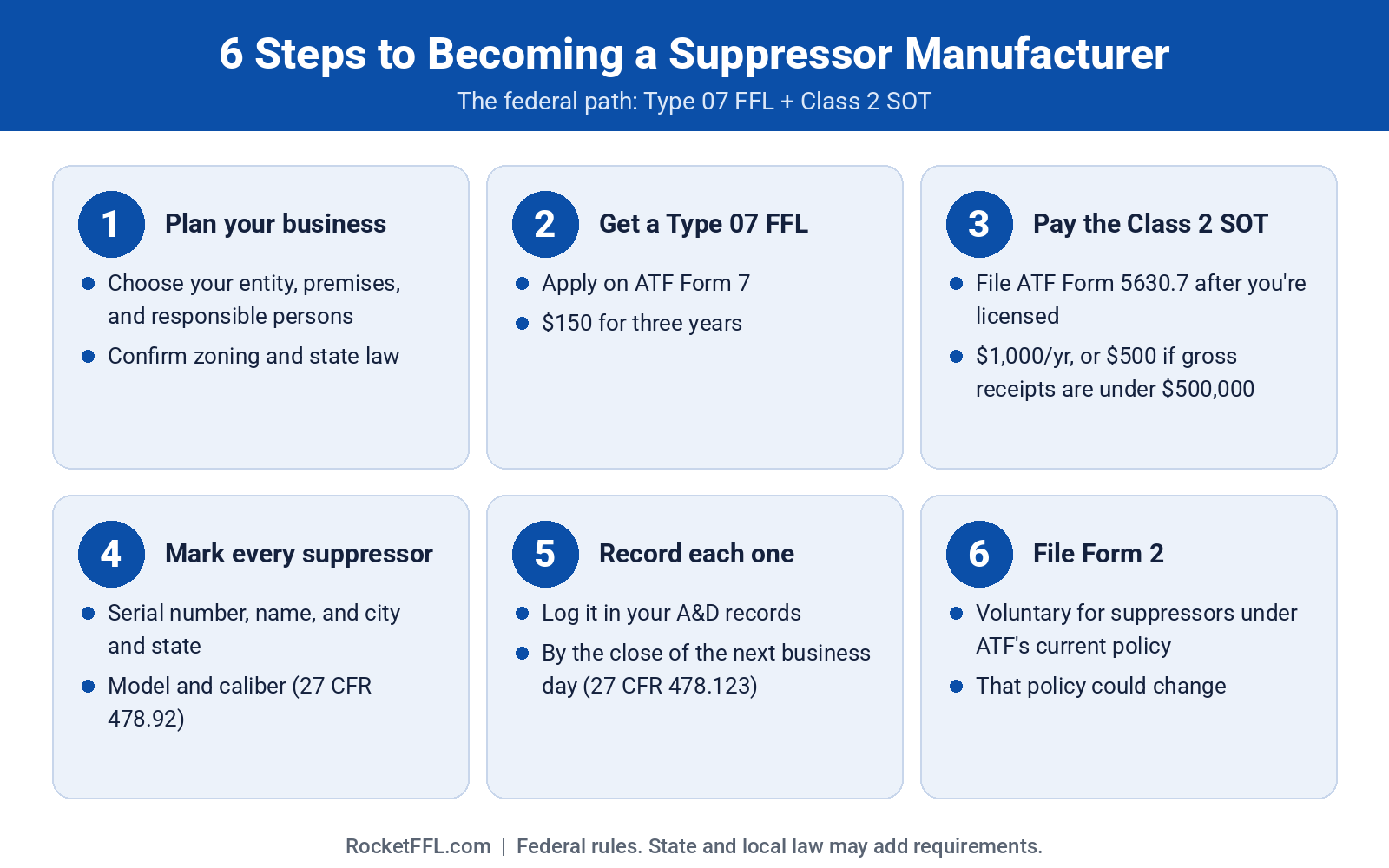
Step 1: Plan Your Business and Premises
Decide how you'll set up (sole proprietor, LLC, or corporation), where you'll work, and who your responsible persons will be. Your premises must be allowed under state and local law, including zoning. Many small manufacturers start at home where zoning allows it; see home-based FFL.
Step 2: Get Your Type 07 FFL
You apply on ATF Form 7. A Type 07 costs $150 for three years. Here's my section-by-section guide on how to fill out ATF Form 7, and what to expect at the ATF interview. A Type 07 also lets you deal in firearms, so you can sell what you make and more.
Step 3: Pay the Class 2 SOT
Once you're licensed, you register and pay the SOT on ATF Form 5630.7. Under 26 U.S.C. 5801, manufacturers pay $1,000 a year, or $500 a year if gross receipts for the most recent tax year were under $500,000. The SOT is due when you start the business and then on or before July 1 each year. More on how it works in What is an SOT?.
This part didn't change. The $0 tax applies to the making and transfer tax on individual items, not to the SOT. ATF's October 9, 2026 letter says those engaged in the business "must continue to pay applicable taxes on their businesses."
Step 4: Mark Every Suppressor
Licensed manufacturers must mark each firearm they make with a serial number, their name (or recognized abbreviation) and city and state (or the FFL-number prefix format), plus model if designated and caliber or gauge (27 CFR 478.92). For a suppressor, complete devices must be marked by the close of the next business day after manufacturing ends, or before disposition if sooner. Silencer parts sold separately must also be marked, with limited exceptions for parts going to other qualified manufacturers for further manufacturing or as repair parts.
ATF says it won't enforce the separate NFA marking requirement for suppressors under its new policy, but the GCA marking rules still apply. ATF's FAQ is clear that manufacturers "must serialize all firearms and silencers."
Step 5: Keep Your Records
Manufacturers must record each firearm they make in their acquisition and disposition records, including manufacturer, type, model, caliber, serial number, and date. For NFA firearms, which include suppressors, the entry is due by the close of the next business day after manufacture (27 CFR 478.123). Dispositions get recorded too, and selling to a non-licensee still means a Form 4473 and background check, unless an exception applies. Records are kept until you go out of business; see how long FFLs must keep records.
Step 6: Form 2 Notices
Under the regulations, a qualified manufacturer reports what it makes on ATF Form 2, filed by the close of the next business day, and that filing registers the items (27 CFR 479.103).
Under ATF's October 9, 2026 enforcement policy, registration of suppressors is no longer required, and ATF says manufacturers "are allowed" to report on a Form 2. In other words, it's voluntary for now. Before you stop filing, remember that many state laws tie lawful possession to NFA registration, and ATF's policy could change.
The $0 Tax and ATF’s Enforcement Policy: It Could Change
The One Big Beautiful Bill Act cut the NFA making and transfer tax on suppressors, SBRs, SBSs, and AOWs to $0 (it's still $200 for machine guns and destructive devices). Then a court ruled in Silencer Shop Foundation v. ATF that the NFA's registration provisions couldn't be enforced for those items against the plaintiffs, and on October 9, 2026, ATF announced it would stop enforcing them against anyone as a matter of enforcement discretion.
That's an enforcement policy, not a change in the statute, and ATF itself says enforcement could resume. For the details, see my breakdown of ATF’s NFA non-enforcement policy. For a manufacturer, the takeaway is simple: the license, the SOT, marking, and records still apply, and you should build your business so it stays compliant if the policy changes.
ITAR Registration: What Changes on November 20, 2026
Manufacturers of items on the U.S. Munitions List (USML) generally must register with the State Department's Directorate of Defense Trade Controls (DDTC), even if they don't export (22 CFR 122.1). The Form 7 instructions flag this for manufacturers too.
Under a State Department interim final rule published July 23, 2026, and effective November 20, 2026, suppressors for semi-automatic and non-automatic firearms come off the USML, and their exports move to the Commerce Department's Export Administration Regulations (EAR) (FR Doc. 2026-14943). Suppressors specially designed for fully automatic firearms stay on the USML in Category I(e).
- Until November 20, 2026: making suppressors requires DDTC registration. The Tier 1 fee is $3,000 a year (22 CFR 122.3). ATF's FAQ makes the same point.
- After November 20, 2026: you still need to register if you make anything that stays on the USML, such as machine guns or suppressors specially designed for full-auto firearms. Exports of covered suppressors will fall under the EAR instead.
For the details, see my breakdown of what the ITAR suppressor rule changes for FFL/SOT manufacturers.
A Caution About 1836 LLC v. ATF
You may have heard about a new lawsuit, 1836 LLC v. ATF, No. 3:26-cv-03535 (N.D. Tex.), filed October 9, 2026, and assigned to Judge Brantley Starr (court docket). It's a Commerce Clause challenge tied to Texas HB 957, arguing that the federal manufacturing license shouldn't apply to suppressors made and sold only in Texas. It's very early, the complaint isn't freely available yet, so exactly what relief the plaintiffs are asking for is unconfirmed, and no court has ruled on anything. A pending lawsuit isn't protection. If you want to make suppressors to sell today, you still need the license and SOT.
Ready to Get Into the Suppressor Business?
The path is clear: get your FFL, pay your SOT, and set up your marking and recordkeeping before you make your first can. My Get Your FFL course walks you through getting licensed, and my SOT course covers becoming an SOT and working with NFA items.
Suppressor Manufacturer FAQ
A manufacturer's FFL, usually a Type 07, plus payment of the Special Occupational Tax as a manufacturer (Class 2 SOT).
$1,000 a year, or $500 a year if the business's gross receipts for the most recent tax year were under $500,000 (26 U.S.C. 5801).
Yes. The $0 tax applies to making and transfer taxes. ATF says businesses must keep paying the special occupational tax.
ATF says manufacturers are allowed to report suppressors on a Form 2 but no longer require registration under its October 9, 2026 enforcement policy. That policy could change, and state law may matter.
Yes. Licensed manufacturers must mark every firearm and silencer they make under 27 CFR 478.92.
Until November 20, 2026, yes. After that date, suppressors for semi-auto and non-auto firearms leave the USML, but you still need to register if you make items still on the USML, like machine guns.
Note: This article covers federal law only and isn't legal advice. State laws on making, selling, and possessing suppressors vary a lot, and some states ban them, so talk to an attorney in your state about state law.
Ready to get your FFL?
Step-by-step course from Ryan Cleckner — applications, compliance, and what ATF actually expects.
Get Your FFL Course →