
Last updated: October 14, 2026. I'll keep this article updated as the 2024 rule's appeal and ATF's rewrite move forward.
If you've got a safe full of guns and you're thinking about selling a few, or you've noticed you can buy a gun at one price and sell it for more, you've probably asked yourself: do I need an FFL to sell guns?
The answer depends on why and how you're selling, not on a magic number of guns. Here's where federal law draws the line, what happened to ATF's 2024 "engaged in the business" rule, and what to do if you're over the line.
The Short Answer
Under federal law, you need a Federal Firearms License (FFL) if you are "engaged in the business" of dealing in firearms. You don't need one to make occasional sales from your personal collection or as a hobby. If you're not sure what an FFL is, start with What is an FFL?.
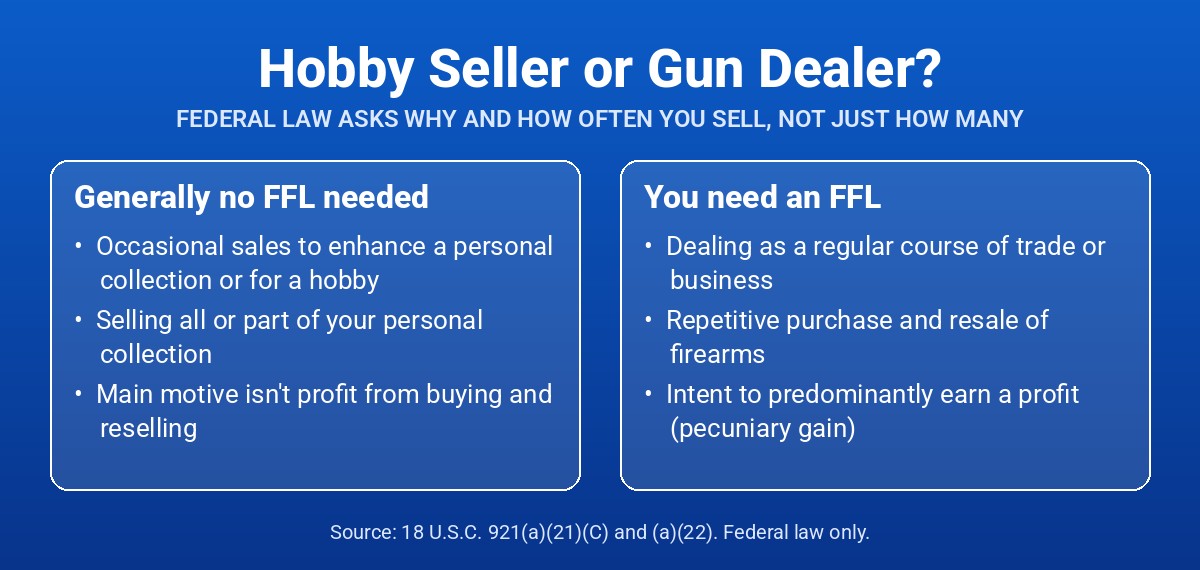
- Generally no FFL needed: occasionally selling, trading, or buying guns to enhance your personal collection or for a hobby, or selling all or part of your personal collection.
- FFL needed: dealing in firearms as a regular course of trade or business, to predominantly earn a profit, through the repetitive purchase and resale of firearms.
What Federal Law Actually Says
The Gun Control Act makes it illegal to engage in the business of dealing in firearms without a license (18 U.S.C. 922(a)(1)(A)). Congress defines "engaged in the business," for a dealer, as a person who "devotes time, attention, and labor to dealing in firearms as a regular course of trade or business to predominantly earn a profit through the repetitive purchase and resale of firearms" (18 U.S.C. 921(a)(21)(C)).
The same sentence carves out a person "who makes occasional sales, exchanges, or purchases of firearms for the enhancement of a personal collection or for a hobby, or who sells all or part of his personal collection of firearms."
Notice what's not in the statute: a number. Federal law doesn't say "five guns a year is fine" or "ten makes you a dealer." It's about the pattern and the purpose.
The BSCA’s “Predominantly Earn a Profit” Standard
Before 2022, the test required a "principal objective of livelihood and profit." In other words, you basically had to be trying to make a living at it. The Bipartisan Safer Communities Act (BSCA) changed that in June 2022 to "predominantly earn a profit."
The statute now defines that phrase to mean "the intent underlying the sale or disposition of firearms is predominantly one of obtaining pecuniary gain, as opposed to other intents, such as improving or liquidating a personal firearms collection" (18 U.S.C. 921(a)(22)).
That's a real change. You no longer have to be trying to make a living. If your main reason for buying and reselling guns is to make money, you can need a license even if it's a side gig and even if you have a full-time job. The statute also says proof of profit isn't required for someone who regularly and repetitively buys and sells firearms for criminal purposes or terrorism.
Selling From Your Personal Collection
Selling guns from your personal collection is expressly protected by the statute, and so is liquidating it. A few practical points:
- Selling off a collection, even a big one, isn't dealing by itself. The statute specifically excludes someone who "sells all or part of his personal collection."
- Upgrading or trading is fine. Occasional sales, exchanges, and purchases to enhance a collection or for a hobby are excluded.
- Buying to flip is different. If you're buying guns so that you can resell them at a profit, and you do it repeatedly, that looks like the business the statute describes, whatever you call it.
- Your motive matters. The question is whether your intent is predominantly pecuniary gain or something else, like improving or liquidating a collection.
Even a lawful private sale has federal rules. For example, an unlicensed person generally can't sell a gun directly to a resident of another state; that has to go through an FFL (18 U.S.C. 922(a)(5)), and you can't sell to someone you know or have reasonable cause to believe is prohibited (18 U.S.C. 922(d)). See my guides to firearm transfers and gun background checks. A recent Fifth Circuit decision held parts of the interstate rules unconstitutional, but it isn't in effect; here's my breakdown of the Fifth Circuit interstate handgun sales ruling.
What Happened to ATF’s 2024 “Engaged in the Business” Rule?
In April 2024, ATF published a final rule, effective May 20, 2024, that added a long list of definitions and "presumptions" about when someone is engaged in the business (89 FR 28968). It also narrowed what could count as a "personal collection." That rule was in 27 CFR 478.11 and 478.13. Here's where it stands as of October 14, 2026:
- Vacated by a federal court. In Texas v. ATF (N.D. Tex. No. 2:24-cv-89), the court first blocked the rule for the plaintiffs in June 2024. On June 12, 2026, it entered final judgment vacating the rule. On August 13, 2026, it denied the government's request to narrow that judgment, ruling that the rule "remains VACATED in its entirety" (court docket).
- On appeal. On October 9, 2026, the Justice Department filed a notice of appeal to the Fifth Circuit. The appeal doesn't by itself bring the rule back.
- Being rewritten by ATF. On May 6, 2026, ATF proposed repealing most of the 2024 rule, including the presumptions, while keeping the statutory definition and a revised "predominantly earn a profit" definition (91 FR 24424). Comments closed August 4, 2026. As of today, I haven't found a final rule in the Federal Register.
- Another court agreed it went too far. In Butler v. Bondi (N.D. Ala.), the court ruled on September 30, 2025, that ATF exceeded its authority and permanently blocked several provisions as to the plaintiffs and NRA members. That case is on hold while ATF finishes its rulemaking (court docket).
One confusing detail: the official eCFR website still prints the 2024 text of 27 CFR 478.13. The eCFR doesn't update for court rulings, so don't treat that as the rule being in force.
What this means for you: the 2024 presumptions are gone for now, but the statute isn't. ATF has said its authority against unlicensed dealing "comes from the law," not the 2024 rule, and that it remains unlawful to deal in firearms without a license. The law here is still moving, so I'll update this article as the appeal and the final rule develop.
What Happens If You Deal Without a License?
Willfully engaging in the business of dealing without an FFL is a federal crime that can carry up to five years in prison and a fine (18 U.S.C. 922(a)(1)(A), 924(a)(1)(D)). It's not worth guessing. If you're close to the line, either scale back to genuine collection and hobby sales or get licensed.
If You Want to Sell Guns as a Business, Get Your FFL
The good news is that getting an FFL is easier and cheaper than most people think. A Type 01 dealer license is $200 for the first three years, and many people run one from home. See how to get a home-based FFL, what an FFL costs, and the FFL license types. With a license, you can buy at dealer prices, ship guns directly with other FFLs, and run your business legally.
When you're ready, my Get Your FFL course walks you through choosing your license, zoning, the Form 7 application, and the ATF interview.
Do I Need an FFL to Sell Guns? FAQ
Federal law doesn't set a number. The test is whether you deal in firearms as a regular course of trade or business to predominantly earn a profit through repetitive buying and reselling.
Yes, under federal law. The statute excludes a person who sells all or part of his personal collection of firearms. State law may add requirements.
Under 18 U.S.C. 921(a)(22), it means your intent in selling is predominantly to obtain pecuniary gain, as opposed to other intents, such as improving or liquidating a personal firearms collection.
No. A federal court in Texas vacated it in its entirety in June 2026 and reaffirmed that in August 2026. The Justice Department appealed on October 9, 2026, and ATF has proposed repealing most of it.
Not just for that. A profitable occasional sale isn't the same as dealing as a regular course of business through repetitive purchase and resale.
Note: This article covers federal law only and isn't legal advice. State laws on private gun sales vary a lot, and some states require background checks or other steps for private sales, so talk to an attorney in your state about state law.


0 Comments