
Getting a Federal Firearms License (FFL) is easier than many people think, but there are specific federal, state, and local requirements you must meet before ATF will give you a license.
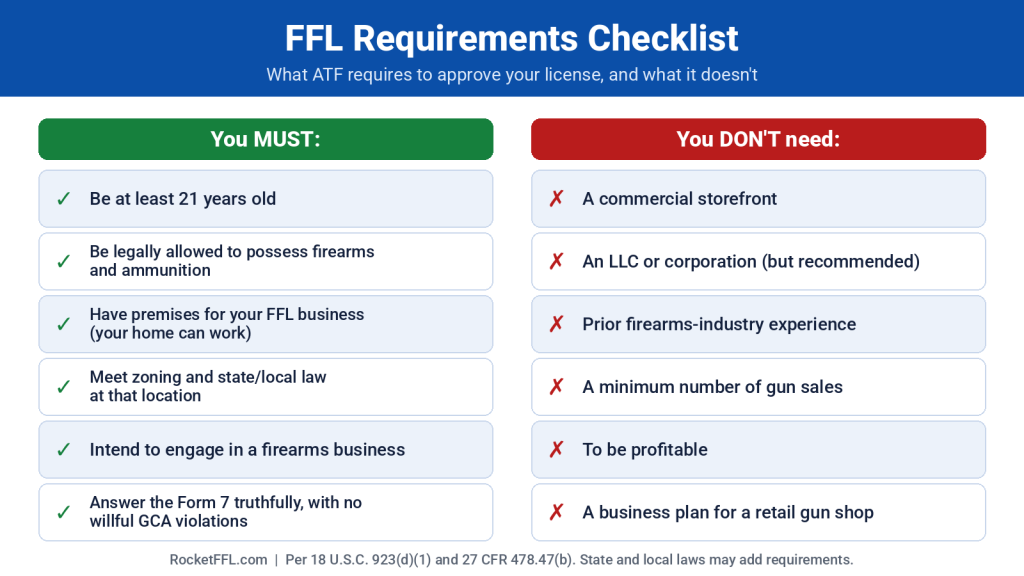
At the federal level, you generally must be at least 21 years old, be legally permitted to possess firearms and ammunition, have a location where you can conduct your FFL activities, comply with applicable state and local laws at that location, and intend to engage in a firearms business.
You do not need a traditional gun store, an LLC (however, I recommend that you use one), prior firearms-industry experience, or even a commercial business location. In fact, many FFLs operate from their homes.
In this guide, we'll break down the FFL requirements for both individuals and businesses, including personal eligibility, business intent, location and zoning requirements, and even some state and local considerations.
If you're looking for the entire process rather than just the requirements, see our Get Your FFL Guide for the complete roadmap from deciding whether an FFL is right for you all the way through how to get your license.
FFL Requirements at a Glance
| FFL Requirement | Absolutely Necessary? |
|---|---|
| At least 21 years old? | Yes |
| Legally permitted to possess firearms? | Yes |
| U.S. citizenship/legal qualifying status | Yes |
| Business premises (can be home) | Yes |
| Commercial Storefront | No |
| LLC or Corp | No |
| Zoning compliance | Yes |
| Prior firearms-industry experience | No |
| FFL Course | No |
| Business intent | Yes |
What is an FFL?
Having an FFL license means that someone may engage in the business of buying, selling, and/or making firearms.
Depending on which of the FFL license types you get, guns can be purchased and sold as part of a business, guns can be manufactured for sale, and/or firearms can be imported. Each type has its own fee (see FFL license cost by type).
If you also become an SOT, you can be a firearm dealer or manufacturer that works with NFA firearms like silencers (suppressors), short barreled rifles (SBR), machine guns, and more.
You don't need to be a full-fledged FFL dealer or manufacturer, you can have an FFL just to make money on an FFL transfer by charging an FFL transfer fee, or you can be a gunsmith.
FFL Meaning
The term FFL means "Federal Firearm License."
The term FFL is also sometimes interchangeably used to refer to the holder of an FFL.
Therefore "FFL" refers to the actual license and also the person/entity that holds the license (the licensee). Therefore the term can be used to describe a gun dealer as an FFL and also the license that the gun dealer has.
FFL License Requirements (Generally)
Contrary to popular belief, the requirements to get an FFL aren't that hard.
In fact, if you can possess a firearm, you are at least 21 years old, you can fill out an ATF form, and you have a location for your license, then you can get an FFL.
It's just about that easy.
FFL License Requirements
- Be a U.S. citizen or otherwise legally allowed to have firearms in the U.S. (for example, a lawful permanent resident; see foreign persons and firearm possession)
- Be at least 21 years old
- Be legally allowed to possess a firearm and ammunition
- Have a location for conducting FFL activities (home-based FFLs are the most popular FFLs in the country)
- Ensure that your business activity at that location meets zoning requirements
- NOT have violated the Gun Control Act (GCA) or its regulations
- NOT lied on your FFL application
[ 18 U.S.C. 923(d)(1) ; 27 CFR 478.47(b) ]
Of course, this is a simplified version of what is needed.
The full requirements for getting an FFL can be broken down into two major categories:
- FFL license requirements for individuals (you), and
- Business/entity requirements for an FFL
FFL Requirements for Individuals
In order to get an FFL from the ATF, you need to be able to possess firearms and ammunition.
There are certain people who do not meet the requirements to get an FFL (nor may they possess firearms or ammunition). These people are considered "prohibited persons" by the ATF and they include anyone who:
- is a felon
- has been convicted of any crime punishable by more than a year in prison (whether or not they were ever sentenced to or served a day in prison)
- is under indictment for any crime punishable by more than a year in prison
- is a fugitive
- is an unlawful user of any controlled substance
- has been adjudicated as a mental defective
- has been committed to a mental institution
- is an illegal alien (or, with limited exceptions, is in the U.S. on a nonimmigrant visa)
- has a dishonorable discharge from the military
- has renounced their U.S. citizenship
- is the subject of a restraining order restraining the person from harassing, stalking, or threatening an intimate partner or the child of an intimate partner, or
- who has been convicted of a misdemeanor crime of domestic violence
There are a few nuances that you might need to be aware o