
An FFL number is the unique identifying number the ATF assigns to every Federal Firearms License it issues. Beyond identifying the licensee, the FFL number also tells you useful information about the FFL, like the type of license, where it is located, and when it expires.
In this article we will cover:
What does an FFL number mean?

An FFL number is a 15-character identifier consisting of 14 numbers and one letter, divided into six sections.
1-22-333-44-5X-66666
Each section of an FFL number represents a different piece of information about that FFL.
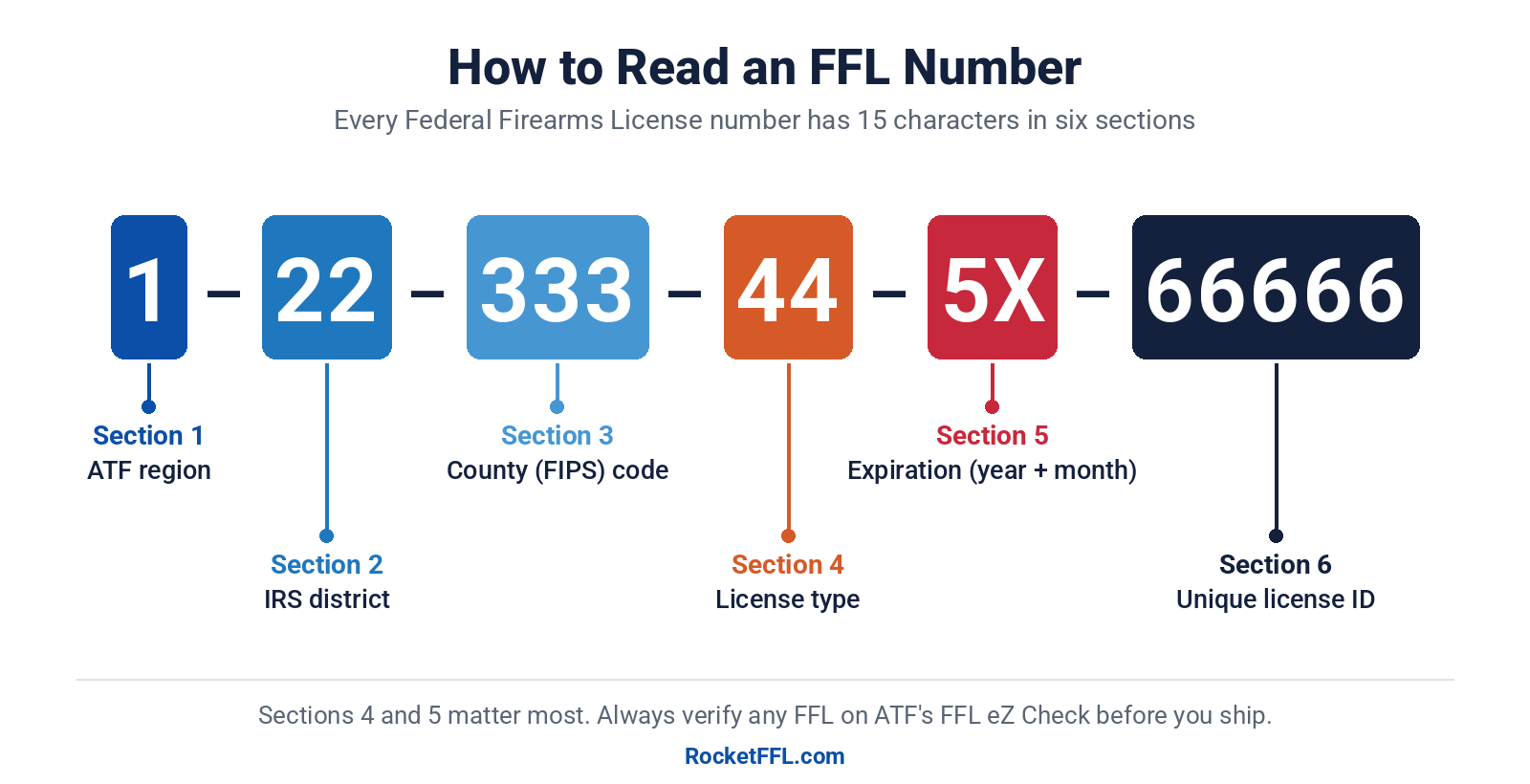
Let's explore each section of an FFL number in order. (As a note, the 4th and 5th section are the most important for you to pay attention to. By paying attention to these sections, you can spot potential issues concerning mismatched locations, wrong FFL types, and incorrect expiration dates.)
The below information can be downloaded and/or printed for easy reference in the RocketFFL FFL Number Reference Sheet available in our ATF Compliance course.
Section 1 of an FFL Number:
The first section of an FFL number is a single digit which represents which of the ATF's 7 regions of the country the FFL is located in. The regions and their corresponding numbers (which skip numbers 2 and 7) are:
1. Southeast
3. Midwest
4. Central
5. Southwest
6. North Atlantic
8. Mid Atlantic
9. Western
Section 2 of an FFL Number:
The second section of an FFL number is a two-digit number which represents the IRS district where the FFL is located.
This is left-over from when the ATF used to be part of the Department of Treasury. Prior to 2001, the first two digits of your company's Employer Identification Number (EIN) used to reference the same two-digit IRS district. As an example, the IRS district office number for Albany, NY is 14. Therefore, if you receive a copy of an FFL from Phoenix, AZ and the FFL number starts with 6-14-XXX-XX-XX-XXXXX, then you know something's wrong.
Even without knowing the IRS district numbers, you know that Phoenix is not in the North Atlantic region of our country. As we'll discuss below, you should always look up an FFL number with the ATF to verify its accuracy.
However, if you're one of those folks who'd like to have a list to reference, check out our free RocketFFL FFL Number Reference Sheet available in our ATF Compliance course.
Section 3 of an FFL Number:
The third section of an FFL number is a three-digit number representing the Federal Information Processing Standards (FIPS) code for the county where the FFL is located. You can generally ignore these three numbers because the FIPS codes change periodically and are even sometimes duplicated for certain areas.
Section 4 of an FFL Number:
The fourth section of an FFL number is a two-digit code that identifies the type of FFL license issued.
That is why this section of an FFL number is an important one to look at - it can easily show a discrepancy on the copy of the FFL you received and it will let you know whether you are allowed to ship the particular firearm to that FFL!
Different FFL types can conduct different activities per the chart below. Note the columns which help you to determine what each type of FFL will allow and which Class of SOT may be required - "AP" means 'Armor Piercing Ammunition' and "DD" means 'Destructive Device'
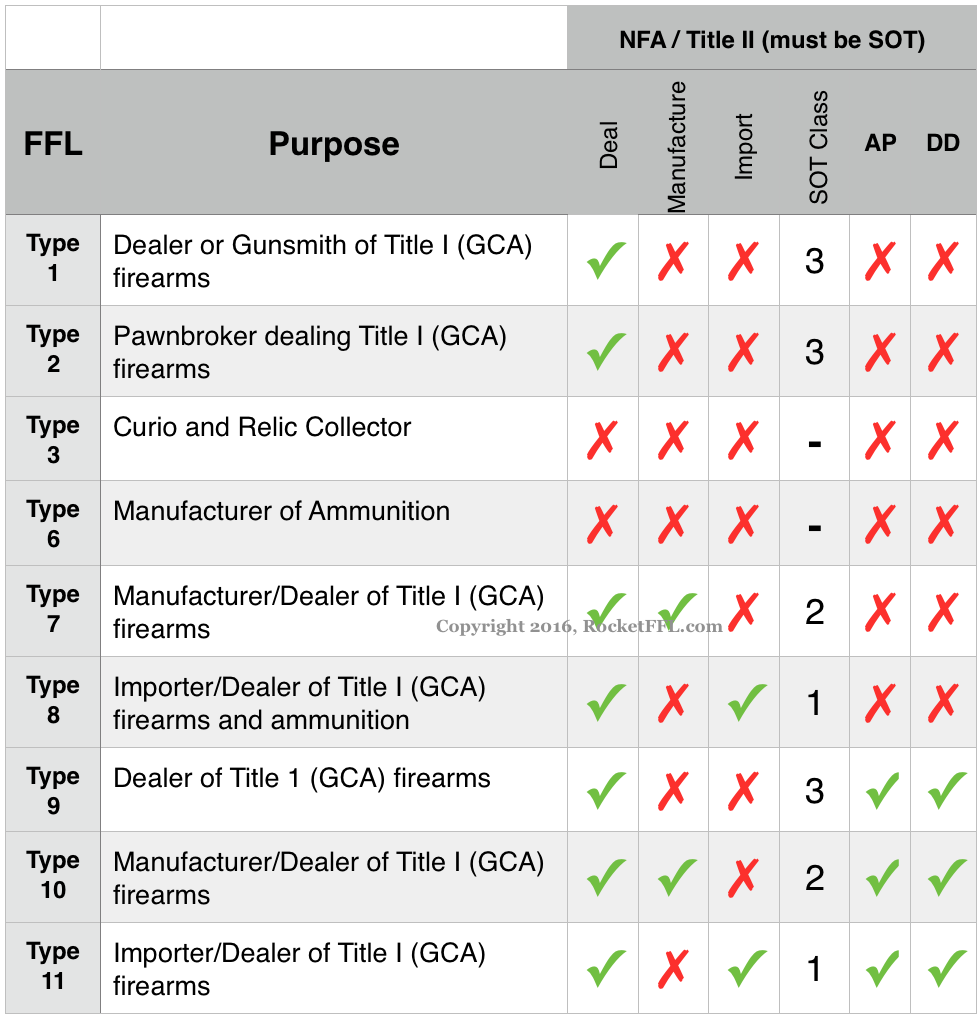
As you can see in the chart above, a Type 1 dealer/gunsmith's FFL (the most common business type of FFL) can deal in standard (GCA/Title I) firearms.
And, if they are also a Class 3 Special Occupational Taxpayer (SOT) then they can also deal in NFA/Title II firearms.
Similarly, a Type 7 manufacturer's FFL (the second most common business FFL) can manufacture standard (GCA/Title I) firearms, and it can deal in them too. And, if they are a Class 2 SOT, then they can also manufacture (and deal) NFA/Title II firearms.
Note how neither the Type 1 nor the Type 7 FFL can work with Armor Piercing Ammunition nor Destructive Devices. To do that, a Type 9, 10, or 11 FFL is required.
The biggest potential issue arises with Type 3 Curio and Relic (C&R) Collector and Type 6 Ammunition Manufacturer FFLs. C&R Collector FFLs (Type 3) can only be used for specific firearms which are at least 50 years old or which meet certain requirements and are on the ATF's official Curio and Relic List.
Ammunition Manufacturer FFLs (Type 6) can only be used for manufacturing ammunition - they cannot be used for firearms. Therefore, you cannot ship a modern firearm to a Type 3 FFL and you can't ship any firearm to a Type 6 FFL. Pay attention to section 4 of an FFL number!