
The ATF Form 4473 is the "Firearms Transaction Record" a Federal Firearms Licensee (FFL) uses when it sells or transfers a gun to someone who doesn't have an FFL. If you've bought a gun at a gun store, it's the form you filled out at the counter.
I'm a firearms attorney who specializes in ATF/FFL compliance under federal law, and I've helped thousands of people get their FFL and stay out of trouble with the ATF. Here are straight answers to the questions I get most about the 4473.
Form 4473 Quick Answers
- What is it? The federal form a licensed dealer must complete for every gun it transfers to a non-licensee.
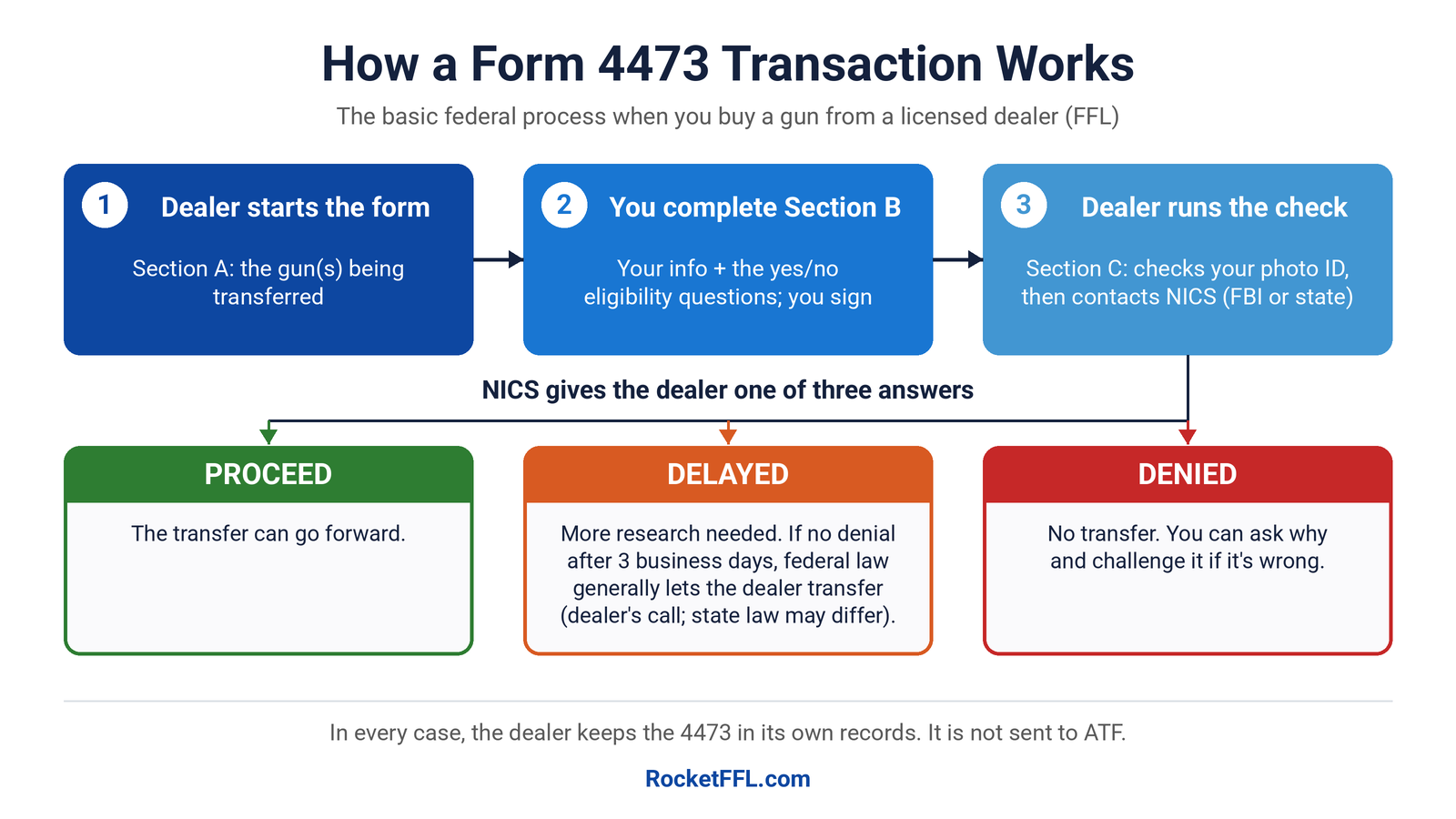
- Who fills it out? You complete Section B (and Section D if needed). The dealer completes Sections A, C, and E.
- Is there a background check? Usually, yes. The dealer contacts NICS and gets a proceed, delayed, or denied response.
- How long does the dealer keep it? Under current federal rules, for as long as the dealer is in business.
- Does it register my gun? No. The dealer keeps it; it isn't sent to ATF.
- Current version: ATF Form 4473 (5300.9), revised August 2023.
What Is ATF Form 4473?
The official name is the Firearms Transaction Record, ATF Form 4473 (5300.9). Under 27 CFR 478.124, a licensed dealer, manufacturer, or importer can't sell or otherwise transfer a firearm to a non-licensee unless it records the transaction on a 4473.
The form does two jobs. It helps the dealer decide whether it can legally hand you the gun, and it creates a record of the transaction that the dealer has to keep.
Federal law is the floor. Rules can vary by state, and some states add their own requirements on top of the 4473.
Who Fills Out the 4473?
You and the dealer each complete different sections:
| Section | Who completes it | What's in it |
|---|---|---|
| A | Dealer (before you start) | The gun(s): manufacturer, model, serial number, type, caliber or gauge |
| B | You, personally | Your information and the yes/no eligibility questions, then your signature |
| C | Dealer | Your ID, the background check, and the NICS response |
| D | You (only if needed) | Re-certification if the transfer happens on a different day than you signed Section B |
| E | Dealer | The dealer's certification, signature, and transfer date |
The form says Section B "must be completed personally" by the buyer. The dealer can't fill it out for you, and a good dealer won't coach you on your answers.
What Does the 4473 Ask? (Section B in Plain English)
Section B starts with your information: name, current residence address (not a P.O. box), place of birth, height, weight, sex, date of birth, ethnicity and race, and citizenship. Your Social Security number is optional, but the form says it "will help prevent misidentification."
Then comes question 21, the yes/no questions most people mean by "the 4473 questions." Here they are in plain English. The official wording on the form is what you're actually answering, so read it carefully.
- 21.a. Are you the actual buyer? If you're buying the gun for someone else, the answer is no, and the dealer can't sell it to you. That's a straw purchase. Under the form's instructions, buying a gun with your own money as a genuine gift is OK, as long as the person getting it isn't prohibited.
- 21.b. Do you intend to sell or give the gun away to further a felony, terrorism, or drug trafficking?
- 21.c. Are you under indictment or information for a felony or other crime punishable by more than a year?
- 21.d. Have you ever been convicted of a felony or other crime for which the judge could have imprisoned you for more than a year, even if you got less?
- 21.e. Are you a fugitive from justice?
- 21.f. Are you an unlawful user of, or addicted to, marijuana or any other controlled substance?
- 21.g. Have you ever been adjudicated as a mental defective or committed to a mental institution?
- 21.h. Were you dishonorably discharged from the military?
- 21.i. Are you subject to a qualifying restraining order involving an intimate partner or child?
- 21.j. Have you ever been convicted of a misdemeanor crime of domestic violence?
- 21.k. Have you renounced your U.S. citizenship?
- 21.l. Are you in the U.S. illegally?
- 21.m. Were you admitted on a nonimmigrant visa, and if so, does an exception apply?
- 21.n. Do you intend to sell or give the gun to someone described above?
Many of these terms have specific legal definitions, and the instructions list exceptions (for example, certain pardons and expungements). If you're not sure how a question applies to you, get legal advice before you answer. My guide to prohibited persons goes deeper.
The 4473 Marijuana Question
Question 21.f trips up a lot of people in states with legal marijuana. The form answers it directly:
"The use or possession of marijuana remains unlawful under Federal law regardless of whether it has been legalized or decriminalized for medicinal or recreational purposes in the state where you reside."
ATF Form 4473 (5300.9), Revised August 2023, question 21.f