
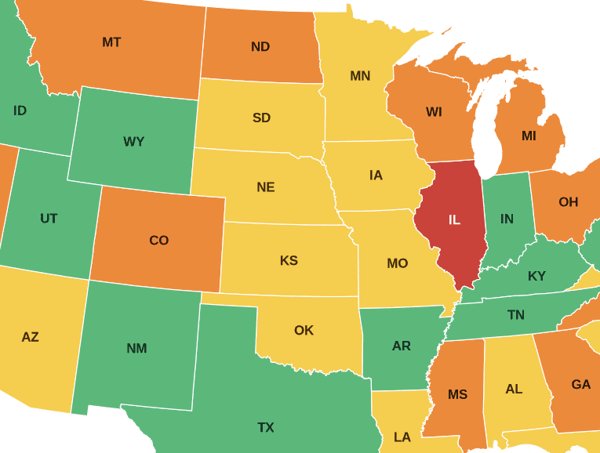
One color-coded map tells the story better than any headline: after ATF's October 2026 NFA policy change, the country isn't split into "free" and "banned" states. FFLSafe's new NFA Items: State-by-State Guide, published October 9, sorts all 50 states plus DC into four risk groups for suppressors, SBRs, SBSs, and AOWs. FFLSafe found that in most of the country, state law still leans on federal NFA registration.
Want the big picture? Start with our NFA guide.
Full disclosure: FFLSafe is the compliance company I founded, and I worked on this research with my team there.
Why this matters: read FFLSafe's legal breakdown
Why a State Map Matters Now
On October 9, 2026, ATF announced that, as a matter of enforcement discretion, it won't require NFA approval or registration for suppressors, SBRs, SBSs, and AOWs. (I broke down exactly what ATF said in ATF's NFA non-enforcement policy explained.) But that's a federal enforcement policy. It doesn't change state law, and ATF itself said it can't tell you whether an unregistered item counts as lawful under your state's laws.
That's the gap FFLSafe's guide tries to map.
What FFLSafe Found
According to FFLSafe, which says it checked each state's statute text, the 51 jurisdictions break down like this:
- 12 states with no state restriction (green). No state limits on these items and no tie to federal registration. Federal law, including the GCA, still applies.
- 15 "hidden tie" states (yellow). FFLSafe says popular maps often show these states as wide open, but at least one item's legality under state law depends on federal registration. FFLSafe calls this the group where most people are likely to get caught.
- 15 widely recognized NFA-tied states (orange). State law clearly depends on federal registration or federal compliance for one or more items.
- 8 states plus DC that ban these items or require a state license civilians generally can't get (red). FFLSafe lists California, Delaware, Hawaii, Illinois, Massachusetts, New Jersey, New York, Rhode Island, and DC, and says ATF's policy changes nothing there.
Add the yellow and orange groups together and FFLSafe counts 30 of 51 jurisdictions as "tied," meaning state legality of at least one of these items depends on federal NFA registration.
Not All “Tied” Laws Are Worded the Same
FFLSafe also points out that the wording of these state laws matters. Some only protect an item that is actually registered. Ohio, for example, exempts items registered in the national registry, which FFLSafe says leaves no gray area for an unregistered item. Others protect items possessed in compliance with or not in violation of federal law, like Arizona and Missouri. FFLSafe acknowledges that some people will argue ATF's non-enforcement makes an unregistered item "lawful" under that softer wording.
FFLSafe’s Bottom Line (and Where People Disagree)
FFLSafe's conclusion is that in a tied state, you should treat an item held unregistered under ATF's policy as illegal under state law. Its reasoning: Congress hasn't repealed the registration requirement, ATF still describes unregistered items as contraband, and no state court has accepted the "non-enforcement makes it lawful" argument. This is FFLSafe's interpretation, and it's contested. FFLSafe's own legal breakdown lays out a more lenient reading too, and no court has ruled on the question yet.
In that companion article, FFLSafe's core point is that a federal agency choosing not to enforce a law isn't the same as the law going away. Many state exceptions were built on top of the federal registry, so a strict court could ask a simple question: is the item actually registered, or actually in compliance with a requirement that's still on the books? Supporters of a lenient reading say legislatures meant "legal federally, legal here." FFLSafe says both views are reasonable, but recommends caution until states weigh in.
FFLSafe also flags overlap with assault-weapon laws, noting that new 2026 laws in Colorado, Rhode Island, and Virginia can block certain semi-auto SBRs or threaded-barrel hosts even where the NFA item itself is legal.
What This Patchwork Means If You’re Thinking About an FFL or SOT
If you don't have an FFL yet, here's my take. A lot of people are going to want suppressors and SBRs now, and many of them are going to have questions. A dealer who knows their state's rules, and the rules for their customers' states, is going to be worth a lot.
- Your state matters before you open your doors. Where you're licensed affects what you can realistically sell. A business plan built around NFA items looks very different in a green state than in a red one.
- The business side of NFA still requires an SOT. ATF didn't touch the special (occupational) tax for businesses that make, import, or deal in NFA items. If NFA items are part of your plan, you'll need to be an FFL/SOT.
- FFLs can't sell in violation of state law. Federal law still bars a dealer from transferring a firearm in violation of state or local law (18 U.S.C. 922(b)(2)). Knowing the patchwork is part of the job.
If you want to get licensed the right way, start with my FFL course, and if NFA items are part of your plan, my SOT course walks you through becoming an SOT.
Why this matters: read FFLSafe's legal breakdown
Note: This article reports on FFLSafe's research and interpretation as of October 9, 2026. It isn't legal advice. State and local laws change and are open to interpretation, so check your state's current law (and any state you'll travel through), and talk to a qualified firearms attorney about your situation.
Ready to get your FFL?
Step-by-step course from Ryan Cleckner — applications, compliance, and what ATF actually expects.
Get Your FFL Course →